Great documentary filmmaking may just seem on the outside to be the keen observing of events, chronicling unique events while showcasing their unusual nature. But just because you have a good story doesn’t necessarily mean that you can make a great film simply by telling it. Instead, great documentary filmmaking draws the story out, particularly its ideas and conflicts, through two crucial details: good editing and interesting aesthetics.
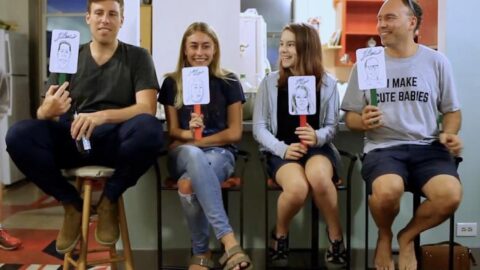
Dad Genes (Craig Downing, 2026), playing in Open Horizons, certainly has a fantastic premise — the reconnection between a sperm donor and his long-lost children — but it suffers from its pedestrian, corporatised approach, so timid in its execution, the conceit loses all spunk. A perfectly amiable experience, but told without an ounce of perspective.
Desperate for money back in the early 90s, Aaron Long spent a year donating sperm. Now it’s rumoured that he might be the father of over 60 children. A gentle artistic soul living in a co-operative in Seattle, he never gave much thought to the fact that he might have more kids than Elon Musk until he saw adverts for 23andMe and decided to send in his DNA. From there, he connects with a variety of children, from teens to early adults, all raised by gay women, and learns, in his 50s, what it means to actually be a dad.
But is he really a dad, or did he just provide some sperm? It’s an interesting question — and he could’ve been an interesting, complex character. But he is never challenged, never made to feel uncomfortable, never made to think about any of this. It’s a real betrayal of what a good documentary should do.
The missed opportunities are manifold. There was so much to explore here (the question of nature vs nurture, the tense relationship between wayward heterosexual men and hard-working lesbian women, the double-standards society places on fathers versus mothers, the true meaning of family, the messiness of falling in love or standing on your own two feet) yet whenever we get the sense that a scene is going somewhere, real implication is quickly brushed over.
Then, midway through the film, a genuine development, worthy of a real romcom (or a Hirokazu Koreeda movie), lands in Downing’s lap, yet is wasted in both its reveal and its culmination. I won’t say what happens, but it’s the kind of plot twist that begs a re-edit of the entire movie to support, yet instead of letting us see how it works by moulding his subjects through finding interesting scenes, Downing just has them tell us instead, completely robbing it of their impact.
The banal music, seemingly licensed entirely from Creative Commons (Kevin MacLeod, the royalty-free king of YouTube, features prominently), sums up the low aesthetic ambition of the project, adding modes and tones at odds with what’s on screen, and, in its cheery, reality TV genericism, patronising the viewer instead of actually inviting them in. Complemented by endless fade cuts, cheap montage sequences, and even lazy font choices that feel slapped on in Canva, Dad Genes feels like an extremely odd choice for an international film festival, where even the really bad movies have some kind of baseline professionalism to them. This is a real waste of a great story.
Redmond is the editor-in-chief of Journey Into Cinema.
- Redmond Bacon

- Redmond Bacon

- Redmond Bacon
- Redmond Bacon