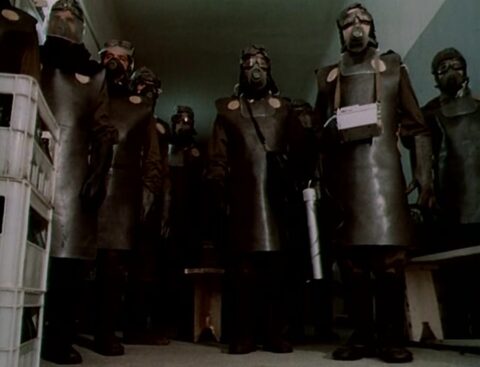
The very first film to tackle the Chernobyl disaster, the Ukrainian SSR film Decay (Mykhailo Belikov, 1990), is the dictionary definition of a hidden gem. Made in the dying days of the Soviet Union, it confounds with its surrealism, provokes with its striking documentary-like images and challenges with its fury towards a regime that allowed such an atrocity to occur on its own turf. As Ukraine faces an existential challenge from the Russians once again, this is an absurdist science-reality film that has only grown in relevance.
It’s a film about Chernobyl. But it’s also a film about Russian arrogance, the unchecked terrors of nuclear power, the callous ignorance of those in power, and the small, helpless people caught in the middle of the epic tides of history. It’s a must-watch — and a great selection choice by the Berlinale Retrospective team.
Sergey Shakurov stars as journalist Aleksandr Zhuravlyov, who starts the film with a lie. After a trip to Athens, he realises that he forgot to bring some earth for his father, who is a Mariupol Greek. So he picks up some dirt from the floor outside their apartment block and pretends it’s the same soil. Sasha is not exactly a likeable person, but Belikov makes us feel for him by immediately painting him as a cuckold; his wife (Tatyana Kochemasova) is in a relationship with a corrupt communist official (Oleksiy Horbunov). Everyone is miserable, no one is telling the truth, right from the bottom to the top.
At first, the thin-seeming characterisations threaten to make for a generic disaster movie along the lines of the truly terrible Airport (George Seaton, 1970) rip-off Air Crew (Aleksandr Mitta, 1980). But once the power station explodes, caught in immersive nightmarish takes that bring us into true Come and See (Elem Klimov, 1985) territory, the film riffs and shakes in a strange, melancholy fashion, begging comparisons to the other Ukrainian Perestroika classic: The Asthenic Syndrome (Kira Muratova, 1989).
Belikov blends an odd, unreal-like tone with documentary-esque footage to awesome effect, capturing the distorted reality of everyday Soviet life. On the one hand, the TV never stops showing the 1986 Peace Bike Race in Kyiv as if nothing is wrong; on the other, men in hazmat suits are patrolling the countryside, animals and people are dying of radiation poisoning, and Kyiv central station is rammed with people simply desperate to get out of the city.
With several digressions along the way, including a mesmeric trip to an end-times church and a young couple more concerned with making love than running for safety, it’s amazing how much simply works. Like Muratova’s classic, it’s all bound by that same tired, end-of-an-era energy; imagining no alternative as a country melts down under its untenable lies. It all culminates in some incredible helicopter footage of an (almost) abandoned Pripyat, accompanied by “Adagio in G Minor” (Remo Giazotto/Tomaso Albinoni), remaking, in my mind, these oft-played “Ghost Town” images anew.
Comparisons to Craig Mazin’s highly acclaimed miniseries Chernobyl (2019) are inevitable. That show is the more meticulously detailed account, taking us from the halls of power right down to the lowliest worker, and remains, at least in the Western imagination, the definitive account of the tragedy.
But Decay is a more poetic excavation of the same tragedy, which evokes something no American adaptation — with non-Russian/Ukrainian/Belarusian actors — could ever do: the ineffable, confused, tragic Slavic spirit. This idea of the “Russian soul” (which has always been composed of many ethnicities and nationalities [but that’s a question for another day]) has been challenged recently — and quite rightly — as a cover for imperalist atrocities, but this defeatist yet humourist atmosphere also goes some way to grasp the paradoxical mentality of living under the Soviet Union, something no outsider from Ukraine or Russia or Belarus, et al, could ever quite capture.
I don’t mean this as a way of pitting both film and TV show against each other. Both are excellent in their own way — and should be seen in conversation with each other. It shows how the same disaster can be seen and appreciated from a completely different perspective. History buffs will prefer the TV show, but for a more auteurist take on the material, Decay is a vital watch.
Redmond is the editor-in-chief of Journey Into Cinema.
- Redmond Bacon

- Redmond Bacon

- Redmond Bacon

- Redmond Bacon