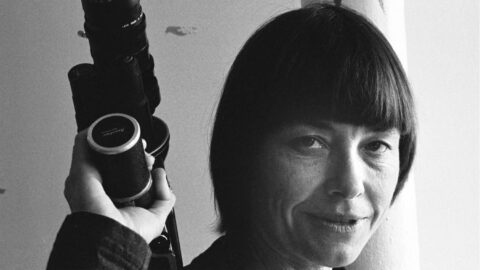
Continuously filming from her late 20s until her death at 79, and with over 80 films to her name, Barbara Hammer is one of cinema’s great outsiders. And part of what makes this work so appealing, as lovingly recounted in Barbara Forever (Brydie O’Connor, 2026), is how it constantly resists characterisation.
She is at once a trailblazing feminist lesbian filmmaker, a fine autofictionist, a restless experimental film innovator and a structuralist genius — as well as a mentor and paver-of-the-way for dozens of LGBTQI+ filmmakers to come, culminating in the huge explosion of queer films in the 90s. It shows that great filmmakers are never, ever one thing, but constantly innovating in form and intent (albeit, for many, within their own rigid aesthetic parameters).
Coralling footage of her films with a trove of unreleased archive footage, as well as interviews with the late filmmaker and her partner Florrie Burke, O’Connor’s documentary is an excellent introduction to the cult filmmaker, as well as an interrogation into why she is considered merely an “outsider” and not respected in the same way as other avant-gardists, such as Michael Snow or Stan Brakhage.
For those who think they have wasted their lives at the end of the 20s, bear this in mind: Barbara Hammer discovered she was a lesbian and embarked on her groundbreaking career at the age of 30.1Previously, she was married to an adventurous man, but like many women of the early 70s, as depicted in the must-read work of Marilyn French, she found true sexual revolution wasn’t possible within any patriarchal structures. Obsessed with the transformative power of the image, she wanted to use the camera to turn the tables on the male gaze, imagining women loving women without their participation.
The excellent Dyketactics (1974) is considered one of the very first — and most important — lesbian erotic movies made by and for actual lesbians; the effect is something innocent and rather waif-like; lily-white ladies prancing in fields, their bodies supple in the light, the film stock itself shimmering between scenes, with only two or three true “money” shots. Beautiful.
But, as Forever progresses, we see how Hammer was constantly trying different things, from the Reifenstahl-like framing in trapeze romance Double Strength (1978), to essentially inventing SubwayTakes in New York some time in the 80s, to the revolutionary political feature length work Nitrate Kisses (1992), exalting all queer people to save everything for the archive, to, eventually, depicting her own mortality through the stirring equine images of A Horse is Not a Metaphor (2009). And she used all forms of camera, from 8mm to video to digital, allowing the medium to dictate form, unafraid of change when seeking new and lively forms of expression — kind of reminding me of the relentless work of Agnes Varda. Watching all of this work in one place was an absolute pleasure.
I’ll be honest and say that I hadn’t heard of Barbara Hammer’s work before I watched this documentary (real experimental film, you know the type, flickering 16mm and overlapping images, riots of sound and light, etc, is not my forte). Yet it has more than served its purpose: making me want to search online and check out more of her extraordinary films. And to be honest once more, while writing this review, I already have. What more can you ask for from an artist biopic?
Redmond is the editor-in-chief of Journey Into Cinema.
- Redmond Bacon

- Redmond Bacon

- Redmond Bacon

- Redmond Bacon