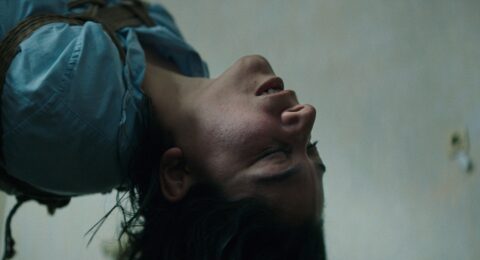
Lust (Ralitza Petrova, 2026) is a small, powerful wonder, an austere and simple work, yet with so much to say about the body, holding on to trauma and finding a way forward, on your own terms. Playing with a trope that has become de rigueur, and a little tired, for a lot of Eastern European (from the Baltics to the Balkans) filmmakers recently — depicting a young person, usually from abroad, returning to their childhood home, learning something about themselves in the process — Petrova’s precise vision, mixing tenderness with a powerful sense of melancholy, makes the genre feel fresh again.
Making the leap from theatre, film debutant Snejanka Mihaylova stars as Lilian, a prison psychologist working in the USA. Her job seems particularly alienating, talking to damaged men through a computer screen. She seems guarded and emotionless, especially as one stands up and calls her a “waste of air bitch.” It’s with an equally listless tone that she returns to Bulgaria to deal with her father’s affairs. Upon consenting to bury him, however, she finds that she has inherited his debt, even though she only met him once.
This stress is a trigger for Lilian, who is a sex addict. In an almost clinical early scene, we see her meet a man in a sauna; she later gives him a graphic handjob. There is no joy in this act, only the desperate need to feel something, anything, in a confusing, downtrodden world. The resultant film walks a careful thread between the bureaucracy, corruption and craven opportunism of Bulgarian society (as according to Petrova!), and Lilian’s inner sexual journey, potently exploring the relationship between childhood trauma and current adult behaviours.
Using mostly static-ish frames (there’s always a bit of uncertain bobble) and careful, striking blocking — shots through doorways, half of a body, unique top-down types of angles — Lust, lensed by Julian Atanassov, is a model of minimalist portraiture, often feeling like a series of Whistler-esque paintings rather than any other conventional cinematic references. It’s all held together by the absolutely captivating Mihaylova, whose use of reticent expressions and deliberate gestures always feels oddly compelling. There are so many ways for this type of story to feel rather slow and plodding, yet, in tune with Carlos E. Garciá’s powerful use of sound design — brimming with low, ambient hums that become its own kind of soundtrack — Lust exerts a curious pull that you simply can’t look away from.
What I was particularly struck by was how, despite the scene-to-scene grimness on display (sad masturbation scenes, even sadder interactions with men, the utter hollow nature of contesting court cases decided in absentia) Lust confidently finds its way through the darkness — especially without the black-and-white conclusions, recycling the (very important, I may add, whatever works for you) clichés from the programme, so many addiction dramas end up in. Rarely has optimism felt so earned, and rarely does bondage seem so freeing. A little miracle of a movie.
Redmond is the editor-in-chief of Journey Into Cinema.
- Redmond Bacon

- Redmond Bacon

- Redmond Bacon

- Redmond Bacon