Films about cults can often be so hypnotic, you might think to yourself, especially ground down by the stresses of everyday life, that perhaps, despite all the coercion and control, there is some pleasure to be had in submitting yourself to the will of a higher power, channelled through a charismatic cult leader. It’s not just true of fiction: documentaries too, with their surfeit of footage — for all their secrecy, cults do love filming themselves — can make these happy-clappy places seem like momentary escapes from the difficulties and ambiguities of our modern condition.
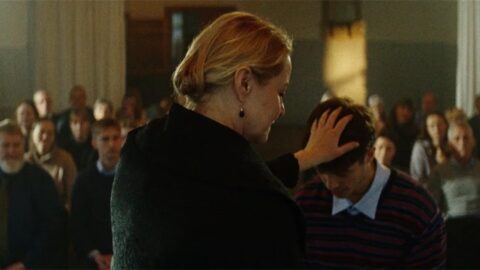
The hybrid documentary Father’s House (Eva Mulvad, Andreas Koefoed, Adam Nielsen, 2026), playing in Doc@PÖFF International Competition, exploring the reprehensible tactics of the eponymous, supposedly still-active Danish cult (it officially closed in 2014), finds a novel solution to this by staging reconstructions of the cult’s most egregious moments as a form of collective, cognitive behavioural therapy. The overall effect is loosely Brechtian, allowing us to see these cults for what they really are: a sophisticated form of charismatic — and extremely dangerous — fakery.
It would be nice, if I ever decide to relive my many educational and professional travails through fiction, to have a world-beating actor to play one of my antagonists: a small-minded teacher played by Gary Oldman, perhaps; my uncaring boss Kristen Scott Thomas.1Yes, I have watched every season of Slow Horses (Will Smith, 2022-26) and think about that sad Slough House office daily.
For Camilla Louise Johnson, a member of the Evangelical Christian sect between 2000-07, her spiritual leader — and tormentor — Ruth Kristiansen, who founded the group in 1990 with her husband Knut, is played by Danish royalty and film festival mainstay Trine Dyrholm. We watch as the actress, opposite Laura Kronborg Kjær as Camilla herself, completely commands the role of manipulative ice queen; then the fourth wall is broken, the switch turns off in Dyrholm’s face, and the curtain falls to reveal that acting and emotional coercion seem to occupy the same emotional and physical space.
Camilla is joined by Jerry Jensen, a disabled man, who, for what it’s worth, finds deep connection in an able-bodied man copying his mannerisms, the unnamed Louise — who reveals how her own children were mistreated by the sect — and the magnanimous Anders Fürstenberg, who finds a way to end the cycle of violence through the simple act of empathy and forgiveness. Their travails are intercut with a little bit of historical background on the group’s workings — including their conflict with a left-wing youth group over a historical building in the centre of Copenhagen — and other archive and internet footage.
While there is a fair amount of emotional mileage to be gotten out of the mixture of reality and fictional recreations — including a startling Possession-esque (Andrzej Żuławski, 1981) bit of physical acting by Emma Sehested Høeg as Ruth’s niece Kristina — it does result in a bit of a stop-start rhythm that, although it forces one to think outside the usual seductive narratives of cults and their indoctrination techniques, ultimately holds the audience at a slight remove. Much to think about, but if I were there alongside these people directing, I might be tempted to say: “Once more, this time with feeling.”
Redmond is the editor-in-chief of Journey Into Cinema.
- Redmond Bacon
- Redmond Bacon

- Redmond Bacon

- Redmond Bacon