When Truffaut talked about how you can’t make true anti-war films, it is unclear whether or not he had seen any sniper movies. Because sniper movies don’t just prove his point; they are the apotheosis of the point: making war look even cooler and more satisfying than any other subgenre of military action thriller.
There’s a reason snipers are so appealing, and so cinematic, from Tom Berenger’s grizzled, cynical loner in Sniper (Luis Llosa, 1993) to Jude Law in Stalingrad-set Enemy at the Gates (Jean-Jacques Annaud, 2001). There’s the scope itself, acting like its own camera, inviting the viewer in as a co-conspirator as our hero surveys the action. There’s the sense that a duel between snipers is an elaborate chess game, involving subtlety, patience and careful counter-attacks. And then there’s the fantasy of being a single vigilante, wreaking vengeance on multiple men from afar, all the while hidden from view, a patriotic ideal that catapulted Clint Eastwood’s deeply misinterpreted American Sniper (2014) to half a billion dollars worldwide.
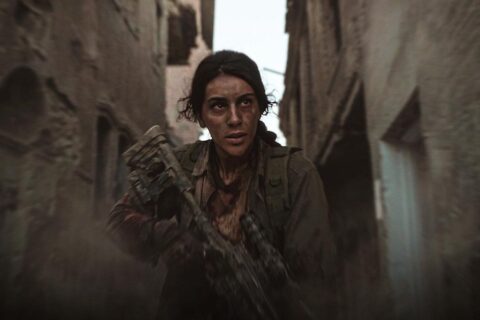
No Paradise If You are Killed by a Woman (Halkawt Mustafa, 2026), featuring an excellent Avan Jamal as the Kurdish-Norwegian Vyan, romanticises and feminises this sniper trope, turning Mosul under ISIS siege into a live-action Modern Warfare map. As we watch our hero devise all kinds of tactics — utilising tunnel networks, mapping out enemy positions, crawling under carpet to avoid detection — to flush out and murder her enemies, then rescue her sister Helin (played at various ages by Mryam Barznji, Dina Rawand and Hesjan Mustafa), we can’t help but be entertained. The action scenes are revenge warfare at its most gripping.
But like all the aforementioned films, another appeal of the genre is the insularity of the hero’s journey. After all, we are watching someone watching; their face as it stares down the barrel a canvas for their struggle. And Jamal does a decent job with the screenplay she has, conveying her own kidnapping while holidaying in Iraq, before her transformation into a Peshmerga avenger — and she is most convincing when crawling or sneaking through crumbling buildings, curtains rustling in the breeze, death lingering around every corner — yet when it comes to the more emotional territory, there’s not much she can do with cringey lines like “the road to freedom is very long,” or saying the enemy is afraid of “women, of life, of freedom.”1I mean yes, but cribbing a line directly from a separate feminist movement in Iran just sounds lazy. Reducing motivation to the bare minimum, Mustafa’s script cannot muster the same potent rage as Eva Husson’s Girls of the Sun (2018), which also focussed on female Kurdish fighters to much more powerful effect.
The issue I have with the approach is that, to convey emotion effectively in an action movie, conflict has to happen through the action itself. Here we have voiceover and dialogue separate from the action — which is fine and perfunctory — and then we have the action itself, which is more or less pretty awesome. The two parts don’t gel holistically, making for a disjointed experience. I didn’t mind too much — the fighting alone is more than worth the price of admission.2But it’s worth being deadly honest here. I can’t name a single sniper movie I don’t like. I even like Behind Enemy Lines (John Moore, 2001).
Redmond is the editor-in-chief of Journey Into Cinema.
- Redmond Bacon

- Redmond Bacon

- Redmond Bacon

- Redmond Bacon