Whenever I go to a bookshop and get a haul for the next couple of weeks or months, I tend to split things 50/50 between literary fiction and detective/thriller novels. Give me an Agatha Christie, Patricia Highsmith, Dick Francis, Jo Nesbo or George Simenon, to name just a few of my favourite writers, and I’ll be content for the rest of the day.
Part of the appeal is not so much about the mechanics of the plot, but the people leading the investigation/cover-ups themselves; whether it’s the pure insight of Maigret, the antiheroes of Nesbo’s or Highsmith’s novels, or the methodical work of Poirot, the people behind detective novels are just as important as the stories they get swept up in.
Yet as detective literature is all about character — with the work either succeeding or failing based on the charisma of its lead policeperson — this allows for a true elasticity of tone, bending form to persona instead of the other way around.
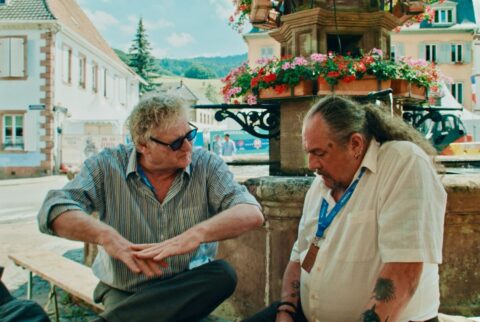
This is excellently portrayed in Claude Schmitz’s lovely Conrad & Crab – Idiotic Gems (2026), which uses its bumbling leads as a launching pad for a digressive shaggy dog story that is much more about people and place than the particulars of the case, which hangs on the slimmest of threads.
The original French title is Sainte-Marie-aux-Mines, which refers to a gorgeous slice of the Alsace located less than 30 miles from the German border. It is captured in lovely verdant greens by cinematographer Florian Berutti, who shoots his scenes slowly on (what appears to be) film, in the Golden Ratio, to stress the town’s old-world charm.
Alain Crab (Rodolphe Burger) and Francis Conrad (Francis Soeten) play two elderly detectives from Peripgnan sent to the region to observe a gem market. Naturally, a 40,000 euro diamond is stolen, triggering an investigation that doubles up as Schmitz’s love letter to this Franco-German region and its strange medley of inhabitants.
In an early indicator of the film’s comic tone, Alain, who is from the region originally, asks Francis to leave a meeting with their female local superintendent, so he can bring up their erstwhile relationship twenty years hence. Handled with a mixture of natural awkwardness and shot in a simple medium distance shot, it sets the way for a series of increasingly fumbled encounters, in which both Crab and Conrad — the latter looking like Russell Crowe if he spent too much time in a biker gang — manage to alienate the people around them while slowly circling their way closer to a bizarre conspiracy involving an Armenian börek restaurant, a German show entitled “Dogs and Motorways,” and endless schnapps in a local pub.
While the plot is as fragile as a diamond is hard, concerns of narrative development are hardly as important as the bickering between the two men, who know each other inside out and, while certainly friends, resent being forced to work so closely, so much of the time. A lot of the comic charm comes from Francis’ excursions into extra-curricular activities, including an affair with a local woman — the ex-wife of a suspect, no less! — instead of focussing on the work at hand. But Crab himself, although more adept at following leads, also manages to get laughs out of an altercation with a victim’s dog and his flailing attempts at rekindling romance with his boss. Together, they form a unique duo. Bad cop, even worse cop.
It all makes for good old-fashioned entertainment; unmistakably French, but with that cosy thriller appeal that British people like me love. How else can I put it: If you ever wanted to see a Pink Panther movie (1963-2009) with double the Clouseaus and an arthouse, relaxed approach to world-building, then Conrad & Crab really is the lowkey gem for you. It scratched an itch I didn’t even know I had. I’d certainly watch these two again.
Redmond is the editor-in-chief of Journey Into Cinema.
- Redmond Bacon

- Redmond Bacon

- Redmond Bacon

- Redmond Bacon