A train from Vienna rattles through St Pölten, and I enter Linz under cover of darkness. None of the verdant landscape is afforded to me. Just black gradations forming clusters in the ether. Hills and mountains leach into the night. No moseying out of der Hauptbahnhof. I arrow to the hotel. Linz is all straight lines.
Opposite entrance and foyer is a perimeter wall coated in dusty peach stucco. A graffitied slogan reads: “Nazis Boxen.” Punch Nazis. Antifascist sentiment is alive and extant. An emblem in OK-Platz, the festival hub, commemorates Franz Jägerstätter, the farmer from nearby Radegund who refused to fight for Germany in World War Two, the subject of Terence Malick’s A Hidden Life (2019). Noticeable everywhere are these marks of resistance, either official or unauthorised.
Signs and symbols betray a longer-held anxiety. The story of Hitler’s schooldays in Linz, and his subsequent laudatory attachment to the city, is now well-rehearsed. Eichmann was also taught here. The authorities have since spent amply reckoning with its past. Linz was European City of Culture in 2009. Its museums and galleries are aggressively modern. The Crossing Europe film festival constitutes another kind of proof: its values statement advocates for “open borders,” “fair working conditions,” “diversity and multilingualism.”

In Bloom
The public realm in Linz tends young. Students spill from die Kunstuniversität. The Danube splits Lentos Kunstmuseum (opened 2003) and Ars Electronica (opened 2009). It’s what cultural placemakers would call vibrant. My first screening on Wednesday morning is the inexplicably asterisked Ninja Motherf*cking Destruction (Lotta Schwerk, 2025, above), part of the YAAAS! Competition, a selection of films about being a nipper, programmed by nippers. The venue (almost like a school hall) is close to full, and the rows behind me teem with impeccably behaved Mitteleuropean teenagers.
These banks of schoolchildren giggle self-consciously at the frank dialogue between Leonie (Emma Suthe) and Marlene (Merle von Mach), Berlin-based best friends discovering sex and its timbre for the first time. These exchanges set up a fairly conventional bildungsroman, filmed by Lotta Schwerk over eight years, mostly using angst-ridden, tactile close-up, in what is her feature debut. We trail the protagonist Leonie while she develops into sexual maturity and self-expression. The first proper relationship forms with Naomi (Marie Tragousti), and their incipient desire is captured evocatively in economical, image-led scenes. They sip spirits awkwardly, laugh uncertainly, kiss tentatively.
A friendship group evolves between the three girls, who hang out playing the film’s titular game (“slapsies” for Anglo-readers), but the dynamic is inevitably complicated. Marlene dedicates herself to a Bachelor’s degree, which symbolises here a version of staid, level-headed respectability. (My university colleagues might wonder.) Naomi, studying theology in Rostock, veers into self-harm. She and Leonie break up, and the latter leaves the capital to work on a farm, grow vegetables and “become a gardener.” Men are intriguingly peripheral throughout, and of the main trio, Tragousti is the most striking performer, host to one of those boundless cinematic faces, at once enigmatic and mobile. The film’s durational quality — the actors age, their haircuts change — is briskly condensed in under 80 minutes, conveying Leonie’s spiritual restoration through a connection to, and cultivation of, the land. Good work.

This horticultural theme pulls me into another showing, Replanted (2025), an hour-long documentary situated in the festival’s Architecture and Society strand, one that foregrounds the experience of Abkhazian refugees displaced during the 1992–93 Georgian civil war. It, too, believes in the power of the allotment to nurture human resilience. Andrea Kalinová, a Slovakian filmmaker, trains her camera on several sanatoriums in Tsqaltubo, once home to extravagant spas and wellness retreats in the Soviet Union, before being transformed into an ad hoc migration camp; now subject to the cycle of regeneration that seeks to restore the baths to splendour. Its remaining inhabitants are the focus, particularly Gia and Nunu, two elderly residents who, together, maintain the grounds while sheltering a steady spawn of stray cats.
The spectre of history is held in vibrating present tense. The pair rail against Russian interference, lament Putin’s imperial ambitions and reminisce about their lives in Abkhazia. The displacement they suffered is shown as part of a lineage, not an aberration. Nunu remarks on a visiting horde, there to take wedding photographs, kitschy youngsters basking in the backdrop of its dilapidated majesty: “Russians are not tourists. Russians are occupiers.” Kalinová, admitting her contrivance, tempts the subjects to reflect on their adaptation to unfamiliar habitats, to draw parallels with the wildlife that surrounds them. Each takes up the offer to philosophise, dwelling on the nature of meaning and memory, and the role that their assiduous routine plays in making a new home. They’ll be on the move again; the wheels of progress keep turning. Montages of archive footage bookend the film, the sunset in Abkhazia mirrored against bygone Tsqaltubo resort revellers, whom the authorities wish will one day return. A thoughtful, if slight, anthropology.

Tales of the Nation
I’m elsewhere curious to see Christian Schocher’s director’s cut of Travelling Warrior (1981, feature) in the retrospective, following a piece of advice from the festival organisers, who tell me straightforwardly that it’s a “Swiss classic.” They’re right — I’m blown away. Shot in grainy and gorgeous monochrome, hyper-fixated on the quotidian, daring in the commitment to picaresque narrative, the film is a revelation: dry, wondrous, melancholy. It stakes its claims from the get-go: “Tell me muse, of the man.” A cosmetics salesman’s own special Odyssey, then, or Leopold Bloom lifted to Zurich and its hinterlands, the tale of a nation in one pathetic man. Hard relate.
Krieger (Willy Ziegler, a nonprofessional actor Schocher met in a bar), is the vector for us, the viewer, as he navigates Switzerland under reconstruction, with its freshly-built motorways, corrosive social attitudes and all-encroaching urban identity. Ziegler’s angular physicality is remarkably adorned: afro perm, celestial eyebags, hangdog expression, stone coloured suit. These characteristics agitate against his otherwise sophisticated comportment. He can handle himself, he flirts, he dances, he drinks copiously. He avoids, where possible, mentioning his wife, who dwells unseen in the budding suburban sprawl. This Gulliver contains multitudes.
Schocher records Krieger’s life at the cusp of daytime and dark, unfurling iridescent sequences of snow-smothered tableaux cratered by beams of light. The director generally adopts a verité style, through which we make assumptions about what’s improvised and what’s not, the points where real life confronts its theatrical impostor. Krieger traverses highlands and lowlands in a bony Citroën, adjusting his wing mirrors to observe the brand logos that proliferate from bars, forecourts and shopfronts: Campari, Gulf, Lindt. I’m struck by the casual dominance of commercial iconography, against which our nonhero is thrust into the consumer capitalist future, thinly armed with mediocre cologne and a sardonic sense of defeat. In one standout, long-take scene, Krieger shares a glass of Moët with a beauty parlour owner, arousing in him a faintly erogenous despondency. He’s scolded for the mismatch between his inhibitions and desires. How does he work away all week long? Only to see his wife on Sunday for dinner? How can he do that to himself? Sighing, Krieger claims that he simply “adapts.” A superlative movie.

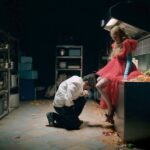
Things can’t get better, and they don’t. But I still have a good time. Signposting through its title a fascination with political paradox, Straight Circle (2025, above) provides some British interest in the fiction competition. It’s a precise, absurdist comedy-drama from audiovisual virtuoso Oscar Hudson, a director as fully-formed and prepossessing as the name implies. He’s made a film that works back exhaustively from its determining metaphor: nationalism creates identity but also confounds it, blurring meaningful connections between friend and foe, between the self and other. The setting is a border outpost demarcating two previously warring countries, locked in a mutually resented ceasefire, conceived in an (im)possible future tense.
Two guards, each from the opposing sides, occupy a lonely station. (To reveal their casting would spoil it.) Inventive colour grades and split-screen entangle them. Both attend to the barb-wire fence, releasing doves in peacetime. The odd-couple, chalk-and-cheese act is heavily signified: one is a “slaphead” and “bootlicker,” the other a “fucking belligerent lowland stult.” Shaved head, long hair. A solider, a civvy. Black beret, red tarboosh. From all lookouts the territory is a flat, cracked, sun-licked death zone. (It was shot in excruciating heat in South Africa.) Flagpoles and salutes amplify the boring folly of service, the quirks of masculinity and, most importantly, the daddy issues pregnant in these duelling combatants.
Some fantastical staging reveals their current motivation: one sticks his head in the ground (literally) to commune with his disciplinarian father, while the foil manifests his pushy mother from a torn photograph. Bodies and personas begin to elide, and the comic horror escalates. Insisting on the world that they’ve created, characters deploy uncanny vernacular that trades in modified profanities: “fuck” is now “uff,” for example. The perennial artifice of community is a ludicrous spectacle, after all, and the final act drills home the point, its set-pieces becoming ever more gruesome and exaggerated. Hudson’s obvious talent means that he’ll make better films, so I don’t mind marvelling at his technique while being concussed by the storytelling.

Fool’s Gold
A stuffy department store is pitched against a breezy hair salon, where young love competes with other young love. The suffocating contour of the shopping mall is accentuated by the hustle-bustle of retailers and customers. No one moves without bumping into someone else, pressed together in a hermetic province of style and fashion. Chantal Akerman’s discordant Golden Eighties (1986, above) transports the audience — we’re in a small screen in City Kino, but there’s enough of us — into a decade mediated through Technicolour, a modest production bedecked by a flamboyant register in thrall to jaunty romcom sentimentalities. I click immediately with the awkward choreography, coordinated costume, busy blocking, charismatic faces, atonal singsongs and helter-skelter blend of irony and sincerity. What’s astonishing is how Akerman constructs a period satire almost contemporaneously, using the MGM musical mode and its modulations to refract a historically specific critique of gender under capitalism. A compelling exercise that confronts its subjects — including, extraordinarily, the Jewish experience after the Holocaust — with more intellect and brio than other haughty, self-serious cinematic idioms.

From the cheerfully gaudy to the painfully lurid. If Pigeons Turned to Gold (2026) is an excoriating personal testimony by the Czech filmmaker, Pepa Lubojacki. Its hybrid memoir approach marries an emotional directness with a formal tricksiness that it never quite reconciles. Lubojacki records her periodically homeless, alcoholic brother as he drifts around the streets of Prague, their home city. We watch a chipper nomad variously become drunk, leave his makeshift dwellings, get temporarily sober, find accommodation, lose accommodation, return to drink, and receive a nearly unconditional stream of support — material, financial, emotional — from his sister, who diligently films their interactions.
Lubojacki is acutely alert to the ethics of her creative method, couched in what I can only describe as an eternally-online aesthetic. Questions are posed in diverse calligraphy — ranging from insipid sans serif message font to upper-caps industrial typeface — that draws attention to the psychological and metaphysical conundrums of her critical endeavour. Self-reflexive commentary covers assorted ground: “Have you ever grieved for someone who hasn’t died?” “This is not the end of the story, just the end of the video material.” All of which does a useful job of recognising our maker’s positionality, even while dulling the suggestive possibilities of the wider text.
Where the film is most provocative is in its AI deployment. Lubojacki manipulates childhood photos of herself and her brother, making their small mouths appear as if they’re speaking from an absent temporality, giving eerie voice to still images of prelapsarian innocence. These interludes paraphrase their relationship to one another and their parents, vocalised in that now-recognisably flat and unearthly robo-lilt. It’s an arresting act of empathy: to invite the viewer into a guiltless past in order to rationalise a traumatic present. Topping that, Lubojacki also renders herself as a pigeon wearing a pork-pie hat, enlarging her eyes and lips using an Insta-filter, delivering diaristic reflections in an auto-tune whine. As such sections demonstrate, it won’t be to all tastes, but this is a deeply felt work that challenges and deliberately fails to resolve its exegesis on addiction.

Symbols and Signs
I close my involvement by catching Renovation (2025, above), a film that I missed in Tallinn last November, a lapse that I eagerly seek to address. I’m very glad I did. Gabrielė Urbonaitė’s first feature is a nimble and candid account of early adult life, following aspiring poet Ilona (Žygimantė Elena Jakštaitė) on the edge of 30, having just moved into a Vilnius apartment with her neeky, emasculated partner Matas (Sarunas Zenkevicius). Despite its attractive concrete façade, the Soviet-era block where they reside is unexpectedly redeveloped, so she crushes on hunky construction worker Oleg (Roman Lutskyi), a Ukrainian hard-hat harbouring a clandestine painterly sensibility. The ceaseless drilling and hammering cause an almighty racket, through which Iveta Macevičit’s caustic sound design generates an accumulating hum of anxiety and desire, disrupting Ilona’s efforts to, in her words, “get used to things.”
There are plenty of cunning observations: Ilona’s forcefully colour-coded book-spines signify the cosmopolitan artiste’s visual code; the “flustered” boyfriend, whose hands shake at the idea of conversation at their housewarming party; the lonesome elderly neighbour, whose flat floods during siteworks, plaintively nodding at the offer of a bed to sleep on. The current geopolitical stakes constitute a phantasmic presence, Russia’s invasion of Ukraine an ever-bubbling allusion piercing the trivialities of home-working and impromptu family visits. In a brief image, we notice Oleg painting over a “Z” that has been daubed onto the building, a Russian pro-war insignia favoured by nationalists and warmongers. Signs and symbols. Symbols and signs.

On my final morning in Linz, I walk through the Mayday parade bisecting der Hauptplatz and over a motorway bridge to the Lentos. After admiring the Max Pechstein exhibition, all bright swirling shades in the accepted expressionist mode, I traipse through to the permanent collection. Among Schiele, Kokoschka and Klimt, I witness the most abject painting that has ever shuffled into my sightline. Fritz Fröhlich’s Farm Children at Play (1941, pictured above) is an exemplary Aryan fantasy: cultivated earth, tamed nature, bucolic landscape, kids in lederhosen. The caption makes fair weather of the displayed artwork, the thread of pure evil it inhabits, contextualising its country scene in the Nazi predilection for Great German Art, which shadowed an equal distaste for all modes and styles deemed to be degenerate. Another well-told story, then — one that’s crucial to retell — which surfaces the contradictions of history, the perils of adapting and maladapting, just as darkness comes again.
Joseph Owen, occasional film critic, is a research fellow at the University of Southampton.
- Joseph Owen

- Joseph Owen
- Joseph Owen

- Joseph Owen