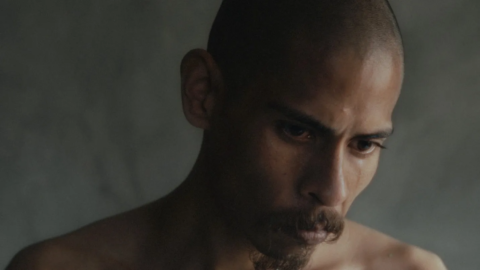
Axel Bertha didn’t set out to make a quiet film, but in his unsettling debut, Against Nature (2026), silence ultimately became its driving force. This stillness carries a deliberate weight throughout the film, laying the groundwork for a deeply sensory experience about the unspoken tension of a lonely man returning home. The Mexican writer-director, who worked as a production assistant on Carlos Reygadas’s Nuestro Tiempo (2018), centres his film on Jonás, a man who comes back to the countryside after years away to work as a stonemason, and who says almost nothing while the film says almost everything through his body and presence.
The story came to Bertha from a police report about a murder that he found in a local Mexican newspaper. Instead of making a documentary, he turned it into something closer to a myth, shot on 35mm with non-professional actors and a script that favours image and sound over plot points or dialogue almost entirely.
At its core, Against Nature is a reflection of human violence, something the film explores with a puzzling question: is human progress taking us further from nature and the world, or bringing us closer to it? This is a bold way to open a career, and Karlovy Vary seems to agree: the film had its world premiere at the festival’s 60th edition, in the Proxima Competition, a section dedicated to films that defy genre conventions.
We sat down with Bertha to talk about violence, religion, working with non-professional actors and how his old mentor Carlos Reygadas came back into the picture as a co-producer.
The film began with a real police report you found about a man who killed his family and disappeared. How did this story transform into Against Nature?
I had wanted to make a film for a long time. The project came from many different sources because, first of all, I had this urge to make a film, even before I knew exactly what it would be about. One of the main sources was the newspaper report you mention, which I found in San Luis Potosí, where we filmed. It sparked my imagination, but not because I wanted to recreate the events or investigate what really happened. It became a point of departure.
From there, I spent a lot of time in the region. I wanted to be shaped by the lives of the people who lived there, by the landscapes and by the place itself. I spent a lot of time observing and simply being present there. That experience gradually shaped the script. At the same time, I knew I wanted to work with non-professional actors from the area, so I spent a lot of time meeting people and scouting locations.
Eventually, all of those elements came together, and we started filming. What interested me was not making a documentary about those events, but allowing that initial story to open up into something else.
It’s interesting that you say you weren’t interested in making a documentary because, especially in the beginning, the film feels deeply rooted in reality. It has the texture of documentary observation before gradually drifting into something more abstract and dreamlike. Was that tone built into the project from the start, or did you discover it during the making of the film? Did you have a script before you went there?
I did have a script before filming. Every scene was written, and even each framing and camera movement was part of the script. The style of the film was not something I approached intellectually. It was more a matter of following my intuition. It felt almost like tracking an animal in the wild and seeing where it led me. The film gradually became what it is today through that process.
Even the parts more rooted in the life of the town were carefully planned. They were staged and constructed. We shot on 35mm film, which meant we had a very limited amount of stock and could not immediately see the results. We were working far from any laboratory, so every take had to be very precise. I wanted to avoid anything feeling theatrical while still maintaining a very deliberate approach.
You mentioned that all the cast are non-professional actors. Why did you choose to work that way, and how did you guide them through a film whose meanings are often conveyed through atmosphere, gesture and presence rather than dialogue?
A: Once I arrived there, it became obvious to me that the film had to be made with people from the region. There is so much in the film about labour, construction and agricultural work. It felt wrong to bring actors from elsewhere. It made much more sense to cast people I had met there and whose relationship to that world was real. Working with non-professional actors is largely about building trust. Being in front of a camera can be intimidating, even with a very small crew. I never showed them the script. I told them what the film was about, but even Jonathan Zarate, who plays Jonás, didn’t know exactly where the story was heading because we filmed as chronologically as possible. What I asked from them was simply to be present. If a scene involved standing up from a chair, crossing a room or picking up an object, I wanted them to do it the way they would naturally do it in their own lives. That was where my focus was. I wasn’t interested in asking them to construct elaborate psychologies for their characters. I wanted them to concentrate on the action itself.
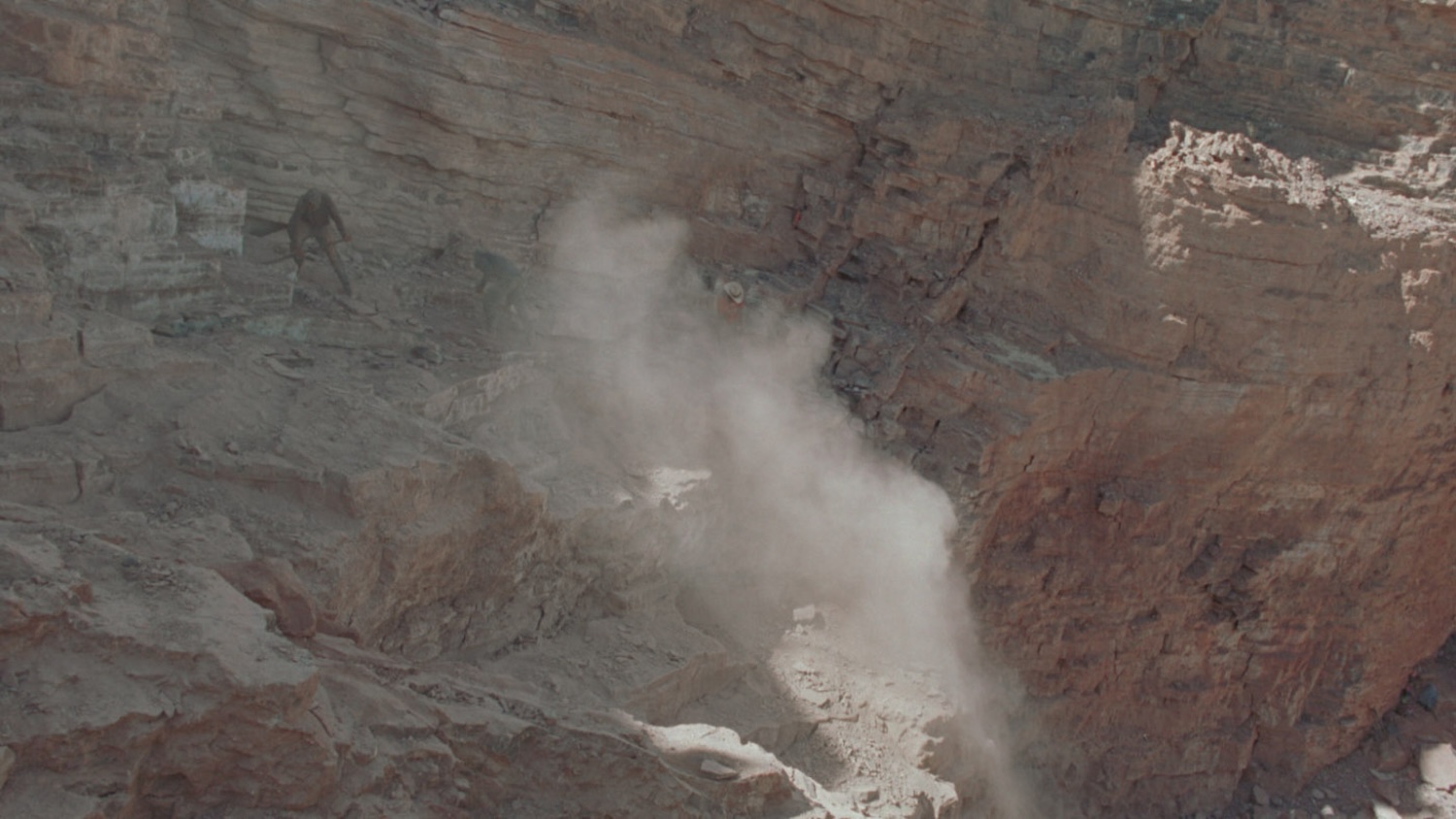
Jonás is an intriguing character, sometimes difficult to grasp. At different moments, he feels like a lost soul, even a kind of apparition. At one point, another character even says he looks like a ghost. How did you think about the character while writing him?
A lot of that comes from the casting. Jonathan brought so much of himself into the film. I wasn’t really asking him to play a role. I wasn’t asking him to suddenly become someone completely different. I wanted him to perform the actions that the film required, and through that, so much of his personality and temperament simply emerged and was captured by the camera.
When I wrote the script, I didn’t want to give the characters too much psychology. Even though the script is very detailed, I wanted the feeling that these were people living their lives and doing things. I think the psychology comes largely from the casting, because people bring their presence, their voice, their eyes, the way they move into the film. And I think that’s enough.
In real life, we don’t have access to what other people are thinking. We only encounter them through what they reveal of themselves. So for me, it’s a matter of trusting that the person you’ve chosen is the right person. I also think that the film you imagine before shooting is one thing, but the finished film should become something much better.
Is the final film close to what you had in mind when you started?
I think it’s beyond anything that I could have imagined because there is a complexity to life and to reality that, when you’re writing a script, you simply cannot grasp.
It is also a very spiritual film. There are several images that seem to evoke religious traditions: the wounds on Jonás’ hands, references to a serpent, and ideas of sacrifice and redemption. How did those biblical references find their way into the film?
Filming in Mexico, and specifically in this region, it felt evident to me that those elements would emerge naturally. The way people understand the world here is deeply informed by Christianity. It’s so ingrained in the culture and in our way of seeing life that it inevitably became part of the film.
At the same time, I didn’t want to make a religious film. What interested me was a very ancient and primordial human feeling: the need to understand the fact that we are mortal, to ask what the meaning of life is, and what our place in the world might be. I wanted to address this drive we have to live in a world that does not care about our existence, a world that doesn’t even know that we exist. The truth is that the universe doesn’t care about us, that it doesn’t even know we’re here. The film is, in part, about a human being confronting that question.
Humanity has been dealing with that question for thousands of years. What interests me is what happens to it today, at a moment when religion is losing ground. So where does that leave us as a civilisation? How do we deal with those questions now? I think art and cinema can become a place where we reconnect with a sense of the sacred, without necessarily returning to religion.
I like this idea of a world that doesn’t know we exist. It makes me think about the violence in the film. If we are confronted with a universe that is indifferent to us, violence almost seems to emerge as one of the ways human beings impose themselves on the world and on each other. The film constantly returns to that tension. What were you trying to explore through it?
There seems to be something in humanity that makes us incapable of not being violent with one another. This aggression towards each other is something that, morally and metaphysically, we have never been able to fully deal with. Religions have tried to address it, politics and philosophy have tried to address it, and yet, for some reason, we seem unable to stop doing it. If you look at other mammals, there isn’t this same level of aggression towards their own kind. Human beings are capable of killing each other, and that’s something I really wanted to address in the film. Where does that come from?
Maybe it’s so essential to who we are that it is also connected to our capacity to develop and grow. The way we use resources, the way we form groups and unite against others, has also been a way for us to advance. There is a logic of competition there that has shaped human development.
I think there is also a very close connection between violence and bonding. Human beings often find it easier to unite against a common enemy than to unite around a common good. That aspect of humanity feels very real to me, and it was something I wanted to explore in the film.
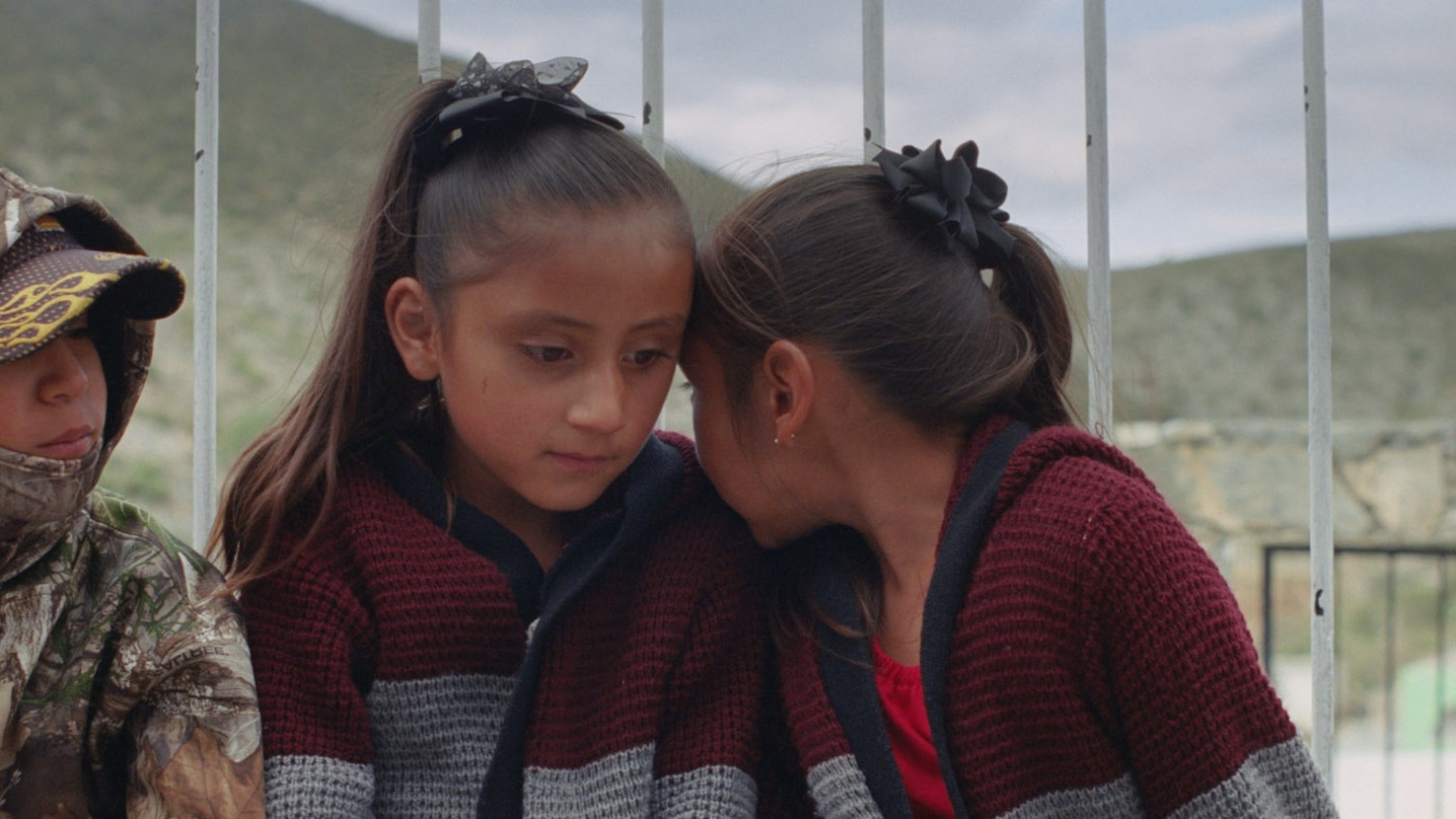
I wanted to talk about the ending. Of course, I don’t want you to give too much away, but the film ultimately confronts us with the possibility of humanity’s self-destruction. Were you interested in the ending as a reflection on violence itself, and on our apparent inability to escape it?
I think it’s evident that it’s a possibility that, in a thousand years, humanity might not prevail. And I think the film speaks to this primitive aspect of aggression. If we’re not able to move beyond it, apart from a natural disaster, the probability of that outcome just keeps growing. Today, it feels even more evident given the technological advances we have at hand.
For me, that possibility is very real. And I think people are interested in art because it helps them deal with the worst things that can happen in life. Tragedy is at the core of human experience, and I think cinema can be a place where we confront life’s hardships. A film can make you stronger by forcing you to face them. When a film really affects me, it helps me deal with the hard things in life once they arrive.
Speaking of films that have affected you, I know Carlos Reygadas has been an influence on your work. He’s also credited as a co-producer on Against Nature. How did that collaboration begin, and what role did he actually play in bringing the project to life?
His films have had a very deep impact on me ever since I first started watching them, as have the films of many other directors. When I was making Against Nature, he became involved during the post-production process. He helped the film by giving us access to Splendor Omnia, his studio in Mexico, where we were able to complete the sound mix and the colour grading. Being able to finish the film there was very important, and his support played a central role in bringing the project to completion.
Beautiful sound mix, by the way. It plays such an important role in the film.
For me, sound is essential. I think about it a lot while I’m writing the script: how much is informed by sound and how much is informed by the image. I think the dialogue, or the tension, between sound and image is one of the things that make cinema such a unique art form, distinct from all the others.
There’s something Robert Bresson said that has been very important to me. The image is a lie. It’s such a reduced version of reality. When you look at an image, there’s nothing of that actual place that remains. It’s only the light that hits the film and gives you the impression of reality.
Sound is different. Sound is able to reproduce the physical element itself. It is doing it again. So what do you do with these two instruments? One is a very reduced version of reality, while the other is able to reproduce so much of reality that it recreates the actual physical phenomenon of the sound itself.
The tension between those two things is at the heart of cinema, and it’s something I thought a lot about while making this film.
Listening to you talk about the connection between sound, image and reality, I get the sense that cinema is more than a form of representation for you.
I think that making a film and watching a film can be an opportunity to regain our relationship with the world. Even if you’re sitting in a cinema, disconnected from the outside in a dark room, it can still become a way of reconnecting with reality. That’s something I felt very strongly while making this film, and I think it’s something we need today. Why make films today when Western civilisation is trying to get by without art?
Cinema is intrinsically tied to the scientific and industrial revolutions. Without it, it simply does not exist. Maybe it can reveal something nothing else can about our moment in time. As our markers to understand the world are at risk, and we are in desperate need of new metaphysics, we might be making a huge mistake in turning a technology of such immense power into an artefact that subjugates not only our cognitive abilities but also our own hearts, our dreams.
Sometimes we forget how much cinema has changed us. Maybe it has transformed us so much that we don’t even notice it anymore. And slowly, through 150 years, it has dramatically contributed to both our understanding and ignorance of ourselves and everything around us. Everything we are watching every day is getting us closer or further away from the world, thus shaping our collective future. Anyone making films today has to be aware of it, take it as the point of departure for every film they make, and decide what they want to contribute.
Wellington Almeida is a programmer, a film writer and a devoted cat lover.
- Wellington Almeida
- Wellington Almeida
- Wellington Almeida
- Wellington Almeida