I can’t help but think that Dice-Ching-O-Mat (Kristijonas Vildziunas, 2026) has come out at least three years too late — or maybe three years too early. Set during the coronavirus pandemic, it doesn’t have the immediacy — or at least novelty — of the contemporaneous films released during that strange, in-between period; it also feels like not enough time has passed for us to start looking back and processing that time properly, especially not by way of ancient Chinese divination practices. The result is a mixed bag of philosophy, insight and family drama that meanders along nicely, but never seems in a hurry to get anywhere fast.
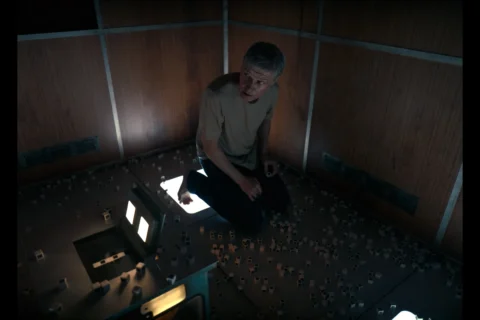
This Lithuanian film, playing in the Baltic Film Competition, stars Dainius Gavenonis as Villis, a professor of Chinese literature, who starts the film stuck in a wooden cube, its claustrophobic dimensions accentuated by a tight 4:3 frame (sequences outside of the box are in widescreen). At first, he believes he is in an elevator, or perhaps some kind of torture chamber, like in the 90s banger Cube (Vincenzo Natali, 1997), but instead the lightly fantastical premise is that he is stuck in the titular Dice-Ching-O-Mat, which spits out chapters in Villis’ life according to that of the ancient divination text, I Ching (Anonymous, late ninth century BC).
As the very man who has translated such chapters as “Darkening of the Light,” “Earth” and “River Forded,” Villis should have a unique insight into how to interpret these messages from the spooky, slightly retro machine and how they relate to his family, especially his daughter Elze (Adele Suminskaite), who is in the hospital. But it seems that he has spent so much time seeking wisdom through his work that he has rarely had time to foster those relationships that truly matter, leaving him on a philosophical journey that transcends conventional narrative structure into something that’s quiet, inward-looking and ultimately, rather tame.
As the I Ching is basically a wise collection of anecdotes, this leads writer-director Vildziunas to engage in some classic clichès of generalist philosophy, such as the repeated fact that the only constant in life is change. Sure. Such a truism persists because, well, it’s true. But the well-worn repetition of the insights here makes for smooth, unabrasive, unchallenging viewing. Nothing in this pleasant film seeks to shake the viewer out of a mere state of contemplation. It’s too happy to play by the rules, instead of finding a way to break out of the box altogether.
I wasn’t really sure how to end this review, so I thought I’d consult the I Ching online. I mean, it worked for the Buddhists, right? The website said that I could ask it any question I wanted, and the ancient texts would provide guidance. I typed in: “How do I end a review about a Lithuanian man who is a translator of the I Ching who realises (perhaps too late) he hasn’t connected with his daughter enough?”
It landed on Hexagram 20, standing for contemplation. In Richard Wilhelm’s 1923 translation, the image reads as follows:
“The wind blows over the earth: the image of Contemplation. Thus the kings of old visited the regions of the world, contemplated the people, and gave them instruction.”
I would do no such thing; only to say that Dice-Ching-O-Mat washed over me like a gentle breeze. An amiable, if underwhelming experience, and one, like the cryptic messages of the I Ching itself — which I may have spent more time reading about than the time spent watching this movie! — that leaves me more quizzically-minded than intellectually or spiritually nourished.
Redmond is the editor-in-chief of Journey Into Cinema.
- Redmond Bacon

- Redmond Bacon

- Redmond Bacon

- Redmond Bacon