After provoking walkouts and heated debates, sharply dividing critics at its Cannes competition premiere, Arthur Harari’s L’Inconnue (The Unknown, 2026) now arrives in Karlovy Vary carrying the reputation of one of the year’s most polarising films.
The Czech spa town didn’t cure it of that reputation exactly. There were still a few walkouts here, too, but away from Cannes’ relentless hype machine, the film seemed to have landed a bit more gently, finding a patient audience among critics and the largely local crowd.
The film is based on the graphic novel Le Cas David Zimmerman (2024), which Harari wrote with his brother Lucas, and the premise is deceptively simple. David Zimmerman (Niels Schneider), a photographer seemingly erased by his own life, has an intense one-night stand at a party with a mysterious woman named Eva (Léa Seydoux). After an almost faint-inducing orgasm, he wakes up trapped inside her body.
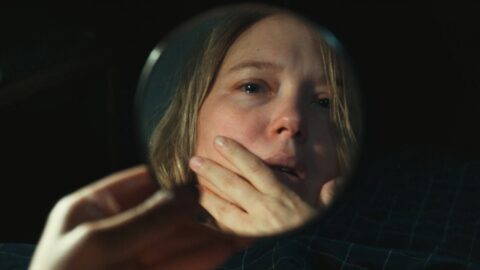
What’s interesting is how fast the film abandons the body-swap logic as its actual subject. Harari isn’t really interested in the mechanics of it; he treats it more like a spiritual illness, a permanent state of not belonging anywhere, where the body ends up as just a shell holding memories, desires and guilt that no longer fit together. You feel this almost right away: after the initial panic and desperate attempts to make sense of what has happened, David starts examining his new body the way you would study a stranger, holding a hand mirror up to his new vagina, trying to reconcile what he remembers with what he now has.
There’s something Kafkaesque about it, set against a Paris that feels slightly ghostly, where every relationship seems contaminated by a sense of imposture. Most unsettling of all, the film never presents this metamorphosis as liberation, or some kind of self-discovery. Instead, it becomes the collapse of the modern idea of the self, where gender and identity cease to offer any emotional or moral stability. Things get stranger still when David finally tracks down his own body, only to find out that Eva, too, has moved on, and that it is now inhabited by Malia (Lilith Grasmug), a young Romanian woman desperately trying to return to her family — to her sister, who is getting married in two weeks, and her loving father, played by Romanian director Radu Jude, in probably one of the most devastating scenes of the film. From there, identity stops being a simple two-person swap and turns into something closer to a moving target.
But L’Inconnue is a very enigmatic film, and Harari has been cagey about what any of this means. In a post-Cannes interview, he did let one thing slip: he wanted to make a film about anxiety. It’s a modest clue for such a strange, enormous puzzle, but it somehow clicks. Once you hear it, the body swap stops feeling like fantasy and starts looking like a physical symptom of something David already had. Even before the transformation, David already moves through Paris like an apparition, wandering the city with his camera, obsessively photographing streets and faces of strangers while never showing his work to anyone. The swap doesn’t create his problem; it just makes it visible. In that sense, the film reaches far beyond David himself; it becomes the portrait of an era that has lost the ability to inhabit the present, to recognise itself in the mirror, or simply to know who it is when nobody is watching.
And just when you think you’ve got a handle on what the film’s doing, it slips away from you again. In fact, there are many films you can lose yourself in here. There’s an obvious reading as an allegory for the trans experience, and Harari certainly leaves that door open, but the film ultimately seems to be reaching for something far more elusive and complex.
Another thread that runs through it, and that felt underexamined to me until the last third clarified it, is desire: bodies only change hands through sex, and only when sex is driven by genuine, uncontrollable lust.
That distinction becomes crucial towards the final act, when Malia, trapped inside David’s body, and David, inside Eva’s, sleep together in the hope of reversing the process. Nothing happens. Not in the way they wanted, anyway. The act has become purely functional, stripped of the primitive desire that triggered every previous exchange. In Harari’s world, bodies don’t simply swap through intimacy; they seem to respond to longing.
Haunted by Cinephilia
Like the film itself, L’Inconnue is also haunted by cinema. You can feel Harari’s cinephilia in almost every frame. Antonioni and Hitchcock are the most obvious influences, and the ones he has openly acknowledged, but they never overwhelm the film or reduce it to some kind of homage. This is a director who knows his masters well enough to stop imitating them.
Harari has spoken at length about his admiration for Hitchcock, and you can certainly feel it here. As in Hitchcock’s films, the camera becomes an instrument of moral voyeurism: a man films a woman playing a man who stares at his own female body, his own nudity, his own sex. Harari doesn’t sidestep the male gaze. He walks straight into it.
And if Bernard Herrmann was Hitchcock’s composer of nightmares, then Andrea Poggio is doing something similar here: a repetitive, oppressive score that recalls the music Jocelyn Pook wrote for Stanley Kubrick’s Eyes Wide Shut (1999). It keeps circling back on itself without ever resolving, much like a promise the film deliberately refuses to fulfil.
But Harari’s cinematic conversation doesn’t end there. Another film kept coming back to me while watching L’Inconnue, one that shares far more with it than it first appears: Kathryn Bigelow’s Strange Days, the 1995 cyberpunk noir built around a technology that allowed people to experience another person’s sensory life in its entirety, even across gender.
In one of its most memorable scenes, Lenny Nero (Ralph Fiennes) sells a hesitant male customer the experience of showering in a woman’s body. He emerges from that session unable to return to who he was before. The scene is almost a blueprint of what L’Inconnue explores over the course of nearly two and a half hours: inhabiting another body is not an adventure but an irreversible form of loss. Strange Days was also a film about collective anxiety: the paranoia surrounding the turn of the millennium, Y2K as an impending apocalypse, the feeling that identity had become something to rent and return damaged. Thirty years separate the two films, but the unease feels almost identical.
What makes the parallel between both films even better is the backstory. James Cameron wrote Strange Days for Bigelow, his wife at the time, to direct. Two very different sensibilities working from the same script, on a film that got widely misunderstood on release and has since been rightly reclaimed. It’s hard not to think of Harari and his own wife, Justine Triet, here. She won the Palme d’Or for Anatomy of a Fall (2024) and shared its Oscar — and César — winning screenplay with him; between the two of them, they’re basically European cinema’s ultimate power couple. Maybe when two people share both a life and a cinematic language, the result inevitably becomes, in one way or another, a film about inhabiting the other. L’Inconnue is precisely that.
If you want the clearest way in, though, it may not lie in Hitchcock or Antonioni or even Bigelow at all, but in Harari’s own cinema. Those familiar with Onoda: 10,000 Nights in the Jungle (2021) will recognise a filmmaker returning to the same obsession from the opposite direction. The Japanese soldier who spends decades on an island convinced the war has never ended is already a portrait of identity as imprisonment, of someone unable to exist outside the only version of himself that has ever made sense. David Zimmerman stands at the opposite end of the same terror: he clings to no identity because he never truly possessed one. Both men require a radical rupture — a war that never ends or a body that is not their own — to finally see themselves.
Perhaps that’s why L’Inconnue ultimately resists being decoded. Every comparison brings us closer without ever pinning it down. And that’s what makes it so exhilarating. It refuses the comfort of a single interpretation, insisting instead that every answer opens the door to another possibility. Some viewers will inevitably reject that invitation. Others will find themselves haunted by it. That willingness to embrace uncertainty is what makes Arthur Harari’s extraordinary third feature one of the defining works of 2026.
Karlovy Vary now offers audiences another chance to get lost inside its labyrinth and, if the film has its way, to leave the cinema no more certain of what they’ve seen than when they first stepped inside. The town’s famous thermal waters may slow your pulse and leave you feeling restored, but L’Inconnue has little interest in putting your mind at ease.
Wellington Almeida is a programmer, a film writer and a devoted cat lover.
- Wellington Almeida

- Wellington Almeida

- Wellington Almeida

- Wellington Almeida