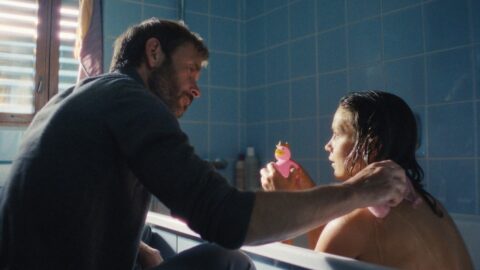
Cute (2026) is about a paedophile who becomes involved with a cam girl performing Lolita fantasies.
There is no elegant way to put it, and the film knows that. Marlene Emilie Lyngstad’s debut, playing in New Directors, places two taboo desires side by side: a man’s attraction to children, which he refuses to act on, and a woman’s paid, sexualised performance of childhood for adults. The question is what happens when those worlds meet — when a desire that cannot be acted upon encounters someone who has turned a version of it into her livelihood, and when the boundaries between fantasy and reality begin to blur. Is this, morally speaking, the best-case scenario for its protagonist? It is an unpleasant film that remains compelling and ambitious, yet for all its provocation, it rarely moves beyond the surface of what it sets out to examine.
Meet Richard (Jan Gunnar Røise), who, at first glance, is an ordinary man in a long-term relationship with the mother of a seven-year-old girl. Richard is a paedophile, and he is attracted to her daughter. They talk about moving in together, but the relationship ends before he acts on his feelings, sending him home to care for his elderly mother. There, he meets Stella (Gina Jaqueline), her caregiver and a cam girl who performs Lolita fantasies online. Their relationship grows out of an unsettling (and convenient) overlap: Richard is trying to contain a desire he experiences as an affliction, while Stella has turned a stylised version of childhood into something adults pay to watch. The film asks whether those two worlds can remain separate once fantasy begins to acquire an emotional reality.
The film never shows Richard openly lusting after children. Instead, it places him in ordinary moments that become disturbing only because we already know what he is attracted to. He plays with his girlfriend’s daughter at a recreation centre; at home he tickles her, helps her brush her teeth, and takes on a fatherly role. None of these actions are inherently sinister, which is precisely why they are difficult to watch. The charge comes from information the audience already possesses. He may be behaving appropriately, but we can no longer view those scenes with innocence.
The contrast with his girlfriend makes Richard’s struggle even clearer. She is presented as unmistakably adult — her curves and silhouette emphasised — so the film shows the adult sexuality he is expected to desire while establishing that it is not what he wants. He struggles to maintain an erection with her and can blame the antidepressants. The excuse is convenient, but his body is already giving him away.
Before the film even gets going, it raises ethical questions it doesn’t appear interested in confronting. The children’s appearance was presumably cleared by their parents, yet parental permission is not the same as a child’s understanding of what they are participating in. Whenever I see an actual child in a film about paedophilia, I find myself wondering what it means for that child to appear, however indirectly, as the object of a predator’s attraction. The concern is not just what happens during production, but what those images might mean years later, once the child understands the context in which they were filmed. Cute opens the question simply by showing the children so closely, then largely leaves it hanging.
The film is mostly careful, and Lyngstad is often stronger as a director than as a writer. Aside from the opening, she resists leaning too hard into the ick of the premise and lets context do most of the work. The film begins with rows of pink, ruffled “girly” socks being manufactured in a factory, then later shows both Stella and the seven-year-old wearing the same pair. Alone, they are ordinary; together, they become deeply unsettling. The child and Stella’s performance of childhood are linked through one banal object, and that single connection does more than most of the dialogue. Beyond this motif and a few glimpses of Stella’s online content, the film largely avoids piling on extra visual discomfort for its own sake, though one sex scene in the middle really does push the limits.
What is missing, however, is much curiosity about Stella herself. The film gives us the outline of her fantasy — the childish clothes, the Lolita performances, the desire to be treated like a little girl —but spends surprisingly little time asking what lies beneath it. Why does she want to regress into childhood? What does she actually get from being someone’s “little girl?” And why does she need a “daddy” figure? The film gestures towards an emotional explanation without really pursuing one, leaving Stella’s inner life largely subordinate to the provocative function she serves in the story. The film is ostensibly interested in what happens when two complicated desires intersect, yet one of those desires is explored primarily as a concept rather than as something rooted in a fully developed person.
Still, the film has many riveting and well-acted scenes. In the best, Richard’s inability to speak honestly about his condition reaches its clearest expression in a doctor’s office. He asks for stronger medication to completely suppress his libido; when the doctor presses him, he comes close to the truth but cannot say it. The camera holds on him; his shame is visible, and the request becomes a confession in disguise. The scene also raises a practical question: should people with these desires be encouraged to self-report for therapy before they act? Richard knows that telling someone could mean help, but also permanent stigma. His silence points to how difficult it is to seek help when admission itself can mark a person for life.
Moments like this show what the film can do when it trusts a single, carefully held observation. The problem is that most of its best ideas remain at that level — sharp, isolated, and never fully developed. Richard and Stella stay largely defined by the central conceit, so their relationship feels less like the meeting of two people than the collision of two ideas. Richard gets the more substantial interior life: we see his shame, his attempts at restraint and his fear of what admitting his desires might mean. Stella, by comparison, remains frustratingly opaque. Once the parallel between them is established, the film leans too heavily on the discomfort of its premise to carry the drama.
At times it risks becoming exploitation dressed up as serious drama — not because the subject is off-limits or because the film sensationalises it, but because the difficulty of the material sometimes does the work that the drama itself should be doing. There is solid filmmaking here: the visual motifs are chosen with care, the director creates a coherent world, and scenes like the near-confession have real force. Cute is compelling stuff. It just needs to dig a little deeper.
Earl lives in Baltimore, Maryland
- Earl Peterson

- Earl Peterson

- Earl Peterson

- Earl Peterson