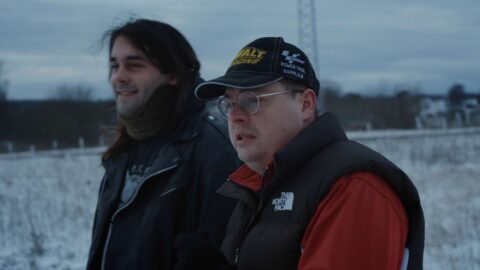
Some people dream of being millionaires. Others dream of untold fame. You and I might simply want a comfortable life, surrounded by the people we love. But for Martin, none of that matters. What he really wants is a 1994 Honda Civic.
Martin has been diagnosed with autism and ADHD, and is suffering from substance abuse issues; the only thing that truly makes him happy in life is cars. The film opens, in a long shot, with him in his new Nissan Micra, showing it off to his best friend Caspar. Unfortunately, the car is quickly totalled, reigniting his dream of owning this classic Japanese car.
The documentary Petrolheads (2026), directed by Martin’s brother Emil Langballe (Martin was adopted as a small child), is a small and modest Danish production, but it carries with it a genuine love of its subject and a great ability to capture the vulnerability of someone whose heart is in the right place but is susceptible to bad habits and the bad people who surround the edges and take advantage of that.
At first, Petrolheads may come off as a quirky character study, but at its core is the story of a friendship between two mentally disabled men who have found a way to bond over a common love. The relationship between Martin and Caspar is a joy to behold, especially the way that such tenderness and care shine through awkward conversations — always avoiding eye contact — and a shared enthusiasm for fixing up broken-down bangers.
Its greatest strength is its ability to tell a profound tale of loneliness, connection and addiction through its small-scale focus, getting great mileage out of its dialogue and its fixed-camera shots of Martin and Caspar driving their cars through the Danish countryside. It makes those moments where Martin seems unfocused and evasive, especially to his best friend, all the more heartbreaking, as we see him succumb to his worst impulses.
Driven to addiction to combat an innate feeling of self-worth that stems from being abandoned as a child, he is tempted by drugs as a means to fight off those negative voices in his head. Here, the film doubles up as a celebration of the common-sense approach to drug treatment in countries such as Denmark, where Martin’s addiction is not seen as an innate character flaw but a cry for help, and is dealt with appropriately. Here he is able to get his bittersweet and deeply ironic ending. People in many parts of the world are not so lucky.