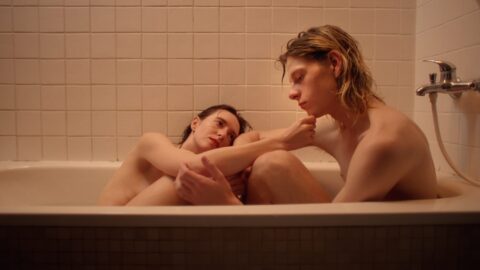
“Do all lovers feel they’re inventing something?” — Portrait of a Lady on Fire (Céline Sciamma, 2019)
I couldn’t help but think of those words from Sciamma’s lesbian drama as I was watching the achingly sincere Tell Me What You Feel (Łukasz Ronduda, 2026), the entirety of which feels like a feature-length attempt to equate falling in love and working through a relationship as some kind of unique, one-of-a-kind art therapy.
On the face of it: a crushingly twee romance. But once you get through these Gen Z kids’ cringe attempts to therapise and externalise all their personal traumas, this excellent Polish drama grows remarkably in meaning and complexity, slyly interrogating whether modern methods are enough to shake us free of complex sociological burdens. Anchored by two excellent performances by young actors Jan Sałasiński and Izabella Dudziak, playing lovers Patryk and Maria respectively, this portrait of two young and messed-up artists is an emotionally deep and resonant work.
Patryk is an impoverished aspiring artist from the sticks; Maria is a rich Warsovian with her own gallery space. He spots her working in the park on a new project, collecting people’s tears in exchange for money. He donates his own, but finds he cannot cry — yet a spark flies between the young couple, and they fall in love fast.
Maria’s work, paying poor people for their tears, in order to make art, seems like a metaphor for Polish (and more broadly, Eastern European) cinema as a whole; monetising poverty and suffering for artistic gain (not unlike Ronduda’s own overwrought queer drama All Our Fears [2021]).1Yet perhaps in its own way, and I haven’t thought this out properly yet, this film shows the new Poland, rapidly developing as one of the strongest countries in the EU, and now able to catch up with their own naval-gazing existential dramas like the Nordics and Germany and France do, versus more downtrodden, economic “Eastern” themes (although this is complicated in the latter stages of this film). Meanwhile, Patryk’s work, based upon his childhood trauma, shows a strong eye for detail and heavy, gothic tones, but has a tendency to over-literalise his upbringing in the simplest way possible. What I appreciated here, however, is the way Ronduda is able to interrogate their work while not punching down at them as artists — these are simply young people trying to figure out the world and their place in it through different forms of artistic expression.
Soon, their sexual and emotional entanglements become their own work of art. In Partryk’s yellowish room, with a bare mattress on the floor and covered in wall-to-wall scribblings, they tenderly discover each other’s bodies, captured in warm tones and sharp contrasts, and a heavy use of soft focus. In one experiment, they wear each other’s clothes and try to understand the other’s feelings; naturally, these kinds of things quickly go wrong, but Ronduda, writing alongside Agata K. Koschmieder, has a knack for understanding the push-and-pull of young love, with inflamed arguments often the fuel to inspire even more lovemaking sessions.
It’s in these moments — staring into each other’s eyes, playing with each other’s feet, intuiting and misintepreting each other’s feelings — that the movie (soundtracked by what sounds like “relaxing ambient and lo-fi hip-hop music to study to;” not a slight, I enjoyed the music), borders on the precious; yet thankfully whenever it gets too saccharine, (a bit too Scandinavian for my liking), the tone pushes back, examining if their holier-than-thou way of interacting actually is the healthiest way to go about things.
After all, therapy-speak is best spoken by a licensed professional; parroted in the hands of the young, it is likely to go terribly wrong — especially once Maria interferes with Patryk’s struggling mother and father. I really appreciated the careful balance of tones here, and the humanity of the characters. While I cringed at most of their actions, I saw a lot of myself, and the common human struggle, in their incomplete yearning for enlightenment — through each other, and through art.
Redmond is the editor-in-chief of Journey Into Cinema.
- Redmond Bacon

- Redmond Bacon

- Redmond Bacon
- Redmond Bacon