“My family album was full of borrowed dogs. We never had a dog. The photographs weren’t true. It’s the sadness of borrowed dogs. We were not satisfied with who we were. That I find heartbreaking.”
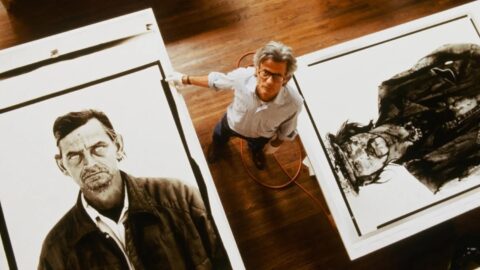
Why do we photograph? How do we photograph? Perhaps for Richard Avedon, it was initially about inventing reality. For Harper’s Bazaar, he lit the 1956-57 Paris like in pre-war films, all glamour and elegance, carefree models dancing in roller skates. He constructed a Paris that did not exist, a Paris that was merely an imagination, much like the imagined childhood, the family pictures in which everyone is always smiling.
Avedon said there is no such thing as objectivity, that any artist picks and chooses what they want to paint or write, and photographers are the same. Ultimately, this was no different from his parents, hiding truths behind borrowed dogs. In a way, his whole life was about resolving this contradiction, moving from a fabrication of this world towards using photography as a tool to reveal the reality, its darkness and tragedies.
For him, the reality is in portraits, starting from those thousands of photos he took of crewmen in the Merchant Marines. Looking at a thousand baffled faces and the way they look at the camera gives you a view of life. Makes you want to understand who they are. But soon Avedon wanted more. To make the mask drop, to capture the truth of a person.
How do you capture the truth of someone like Marilyn Monroe? Avedon exhausted her with a day of shooting, and finally caught her in a brief moment of vulnerability. The split seconds she wasn’t Marilyn the character anymore. As Avedon’s son says, photographers are manipulators. Avedon thought people’s beauty lies in their vulnerability. But who wants to be captured at the moment of vulnerability?
Through such questions, Ron Howard’s Avedon (2026) traces the iconic fashion and portrait photographer’s life, taking viewers on a journey to reflect on the nature of photography. Discovering one’s own life in other people’s faces. Using 8×10 camera to confront the subject face-to-face instead of hiding behind the lenses. An existential white background to focus on the geography of the face. To eliminate so as to reveal what’s important. Avedon’s view is not necessarily the right view, but it gives us a chance to find where we stand.
Ariadne is a film writer specialising in sensory and arthouse cinema.
- Ariadne Si Suo
- Ariadne Si Suo

- Ariadne Si Suo

- Ariadne Si Suo