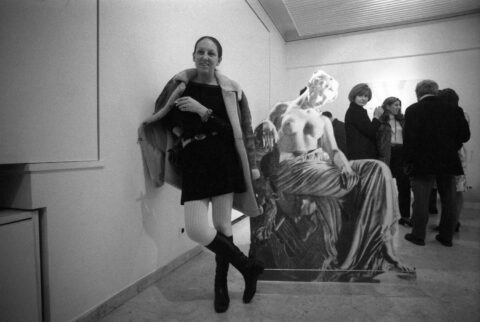
One of Italy’s most prominent feminists and the founder of the female-only collective Rivolta Femminile, in 1970, it is notable that Carla Lonzi’s background was as an art critic. Before she could publish such incendiary works like “Let’s Spit on Hegel” (1970) and Diary of a Feminist (1977), she started her career studying an art form that was, and in many ways, still is, dominated by men.
In a review at the Venice Biennale of a female artist, she compares her limited ability to express herself with the protagonist of Samuel Beckett’s Happy Days (1961), who performs with, first, half of her body, then, nearly all of it, submerged in sand. Art feels insufficient to Lonzi, who pivots into a more direct form of interaction with the world around her.
She is remembered with great love in Francesca Archibugi’s film Carla Lonzi, a Feminist Story (2026), a tender and passionate portrait of this fascinating, oftentimes contradictory figure, coming into public prominence during a time of great social and political upheaval. Mixing archival footage, both shot on film and video, as well as a wealth of excellent stills and talking heads, accompanied by a light jazz soundtrack, Archibugi’s approach is laid-back yet not without reverence, charting Lonzi’s life from boarding school in the 1940s to her forming a feminist collective on the back of the 1968 protests.
It is easy to think that feminism and the general leftist movements of ’68 grew in tandem, but the relationship was actually far more fractured. As the novels of Marilyn French, Erica Jong or Mary McCarthy show, this sense of anarchy and new forms of collectivism often dressed up traditional gender roles under free-love guises. A Feminist Story shows how the feminist movement flourished not due to, but despite, the political revolutions of the late 60s and early 70s.
This is then traced to the modern day, where a young feminist group watches footage about the possibilities of group conversations versus one-on-ones, leading to a discussion about individuality and difference with a member of Rivolta Femminile. Crucially, the younger women, talking about trans and Black feminisms, do contradict the older woman, but always lead with respect, showing how these conversations are constantly evolving, especially as many hard-won victories for women around the world are being rolled back. Looking at Italy in particular, the Berlusconi era was marred by sex scandals and rampant objectification, while the current government, although run by a woman, Giorgia Meloni, are on the far-right.
What makes Lonzi such a compelling figure is that, perhaps informed by the subjective, free-association nature of her criticism, her feminist ideals were not entirely prescriptive. Rather, for example, in her delineation between the vaginal and clitoral woman — the former based on the patriarchal notion of reproduction, the latter on sexual pleasure free from childmaking — she gives women the opportunity to rethink their own relationship to men and sexual freedom. Rather than seeming like an outdated relic of her time, an example of old feminism, her work’s open-endedness can be seen as a blueprint for true self-expression and creativity for women everywhere. A small, inspiring documentary.