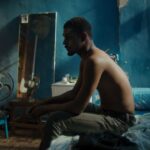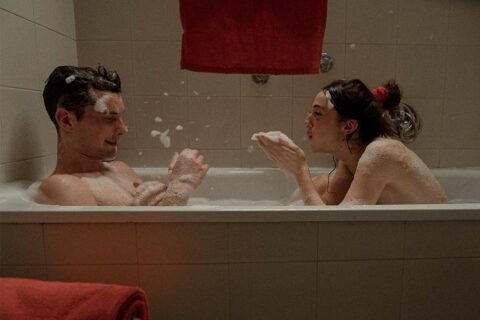
There is something especially unsettling about a murder with no clear motive. The killing of 23-year-old Luca Varani in Rome in March 2016 became one of the most notorious cases in recent Italian history. A working-class guy with a steady girlfriend and a job in a garage, secretly working as a sex worker on the side, Luca went to Manuel Foffo’s apartment, where Foffo and Marco Prato tortured him for hours before killing him with knives and a hammer. Given the brutality and the lingering questions about why it happened, you might expect a film about the case to dig into the circumstances that led there. The City of the Living (2026) does something else.
Edoardo Gabbriellini’s adaptation of Nicola Lagioia’s 2023 book is less interested in reconstructing the murder than in showing Luca as a person who existed beyond the fact of his death. At first, it feels like a deliberate course correction from true-crime habits, especially the way those stories lavish psychology and mythology on the killers while the victim shrinks into the body the plot revolves around.
Here, at least, Luca gets to stay a person and not get the trashy Ryan Murphy treatment, which would mean also spending hours with the seductive, sexy and well-lit killers. But putting Luca at the centre creates its own problem: people start feeling entitled to him. His private life is now something we’re invited to inspect because he’s dead and because someone else has decided those details belong in the narrative. The question that kept returning while I watched was simple: would Luca have wanted any of this public? We have no way of knowing. He can’t tell us what he considered private or push back against the way someone else has interpreted him. That unease becomes sharper when the material involves gay sexuality.
Dead gay men have long been vulnerable to being turned into stories about secrets, shame and hidden desires. Once someone is gone, their closet can start to feel like public property. The deeper problem with this kind of true crime isn’t only that it might exploit a victim; it can also turn someone’s private life into something we feel entitled to know, even when that person went to great lengths to keep parts of it hidden.
It gets even murkier because the film is adapting a book built on uncertainty. Lagioia works from interviews, anecdotes, testimony and recollections that don’t always line up, leaving the reader with a story assembled from other people’s memories rather than a single definitive version. At the same time, the book goes to almost exhaustive lengths to reconstruct what happened in the days and hours before the murder. Foffo and Prato were on a three-day cocaine binge that would make even the biggest addict wince, getting through around 25 grams, along with enormous amounts of vodka and other whims. They were inviting various men over, which, in hindsight, makes the whole thing feel like a lethal game of roulette. There’s no real way of knowing how close anyone else came to being Luca. If Foffo and Prato had taken that one gram of coke a little earlier, or if a different man had walked through the door at a slightly different moment, would someone else have ended up dead?
The book brings that terrifying question up in its final stretch, trying to pinpoint the moment when their fantasies stopped simply overlapping and something stranger happened: when their coke-addled brains seemed to fuse, when they perhaps began communicating without saying anything at all, and when whatever had been a shared murder fantasy started becoming something neither of them could quite pull back from. What makes that randomness so frightening is that there may not be a satisfying explanation for why it was Luca. Because the killers are generally absent, the film never really gets at the possibility that it could have been any number of men who ended up dead that day.
If you’ve read Lagioia’s book, the film carries an especially uncomfortable lamb-to-the-slaughter quality: Luca simply goes about his days while the audience already knows what is waiting, and that knowledge changes how everything reads. A bad decision looks like foreshadowing; a sexual encounter starts to feel like a clue; even an ordinary trip across Rome takes on a sense of inevitability. But Luca wasn’t living toward his own murder. He was just living. The film wants to give him a life beyond his death, yet its knowledge of that death is always shaping how we see him, particularly when it comes to his sexuality.
But Lagioia is after something grander and more ambitious in the book. The murder becomes a way into Rome and the social worlds that overlap there, where class, money, drugs, sex, politics, history, Italian masculinity and respectability keep colliding. There’s something distinctly Pasolinian about it, especially the way class and sexuality tangle together. It also reminded me of John Berendt’s Midnight in the Garden of Good and Evil (1994), where the murder is almost a doorway into Savannah, Georgia itself. You could practically smell the city in that book; you felt the weight of its history, the heat, the old houses, the particular strangeness of the people who lived there.
Both books are fascinated by the secret gay underbelly of their cities, too, specifically rough trade. Lagioia does with Rome what Berendt does with Savannah: the murder becomes a way into a city that feels much stranger and more complicated than it first appears. That’s what neither film really captures. The films show us Rome and Savannah, but they don’t give us the sense of the cities the books create — their hidden worlds, contradictions and mindsets.
Luca’s sex work is one of the places where the film comes closest to the messiness of his interior life: the conflicting desires, the uncertainty about whether he is actually turned on by these encounters or whether they are simply an easy way to make money. A few hours can mean enough for dinner with his girlfriend; he thinks he can read the men he meets and decide who is safe. In Luca’s first foray, a handsome guy pays him simply to watch him watch porn — the easiest john in the world, but they’re not all like that.
The film is helped enormously by Emanuele Maria Di Stefano and Gaia Merlonghi as Luca and his girlfriend Marta. They’re charming as a young couple in love, with a genuine affection for each other even as they get caught up in the usual dramas of a relationship. More importantly, you believe that they see a future together. The scenes of them looking for a flat to share are particularly heartbreaking because they make that future concrete: you’re watching two people make plans for a life that Luca will never get to have. It’s a sad and effective way of giving a sense of what was lost.
The depiction of Marco Prato is where the film becomes considerably more uncomfortable. Lagioia gives more context around his affinity for cross-dressing and stated desire to fully transition into a woman, without ever fully settling what the feminine persona meant: gender identity, performance, fetish or something else. The film strips that ambiguity away. Prato appears very briefly dressed as a woman in a sexual setting, and shortly afterwards we are looking at the aftermath of a brutally violent murder.
The film never claims that Prato’s gender identity or gender nonconformity caused the violence. It doesn’t really have to. Put those images next to each other, and the film almost creates a narrative in which repression, secrecy and gender transgression culminate in death — for both men. That was, in some sense, the reality of what happened. But there is something deeply questionable about reproducing that parallel when one of those lives is so much less explored on screen. Luca’s intimate life is opened up after his death, while Prato’s gender presentation is reduced to a striking image attached to a murderer. It’s giving old-school trans-villain vibes: the gender-nonconforming body becomes part of the visual language of deviance, danger and ultimately violence. I kept thinking of Psycho (Alfred Hitchcock, 1960), Dressed to Kill (Brian De Palma, 1980), Sleepaway Camp (Robert Hiltzik, 1983), and The Silence of the Lambs (Jonathan Demme, 1991)‚ all five-star fictional bangers, btw. I don’t believe Gabbriellini is deliberately making that argument, but he doesn’t seem to notice the connections it invites us to make.
There are plenty of things in City of the Living that could be picked apart, yet its opening offers a more interesting way in. Luca appears first as a baby, as his adoptive parents look at three infants in an orphanage and immediately recognise him as their child. Knowing what happens to him makes the scene devastating: from our perspective, their choice can look like fate, but to them it was simply the moment they chose their son, with no idea what his future would hold.
For a few minutes, Luca exists outside the murder — not yet a sex worker whose private life we can analyse or a victim whose choices we can retrospectively dissect, but simply a child with an unknowable future. It’s one of the few moments where the film manages to resist the urge to turn him into a collection of assumptions and explanations. In that sense, the opening scene is the film’s most meaningful gesture toward giving Luca back to himself.
Editor-at-large Jared loves movies and lives with Kiki in Berlin.
- Jared Abbott

- Jared Abbott
- Jared Abbott
- Jared Abbott