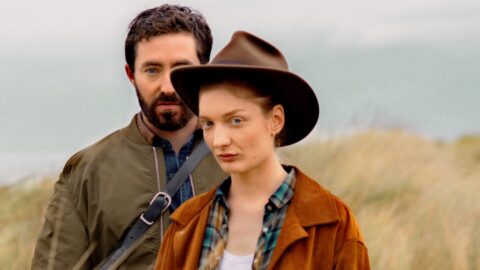
Ann Sirot and Raphaël Balboni’s Un détour par Diane (2026) arrives as a genuine surprise, largely because it so quickly subverts the expectations its premise appears to invite. Diane (Ninon Borsei) learns that her mother was raped years earlier and grows increasingly consumed by the knowledge — what it signifies, what it has done to her mother, and whether anything ought now to be done about it. At first the film seems poised to become a conventional rape-and-revenge narrative, and it is certainly preoccupied with sexual violence and the impulse toward retribution. Yet that impulse belongs to someone who did not herself experience the assault, rendering the proposition stranger. Diane seeks to inhabit, interpret, even appropriate an experience that is not hers. From this premise, the film expands into something harder to pin down: a dark comedy, an intergenerational drama, and only partially a revenge story.
The way we are introduced to Diane makes clear almost immediately that this is not going to be a particularly solemn film. Her first scene is a silly, stylised exchange with a guy she has just met in a club, punctuated by quick flashes of the two of them posing for each other and having sex in all sorts of exaggerated positions. It is cute and funny and ridiculous, and then the fantasy crashes into the much less glamorous mechanics of the hookup. After Diane reaches orgasm, the guy assumes she will continue until he is finished too, and that expectation instantly kills her interest. She calls him on it, and that is essentially that: she has no interest in performing the role he has already assigned her. She is leaving. Bye.
The sequence tells us quite a lot about Diane. She likes men and enjoys sex; there is no particular hang-up about desire itself. What she objects to is the script attached to it — the assumption that heterosexual intimacy necessarily means accommodating male entitlement. She is not rejecting intimacy so much as refusing its default terms. Once her mother’s history surfaces, this way of relating to men takes on a different weight. The film leaves open the possibility that some of Diane’s instincts have been inherited rather than learned: a wariness around men, an awareness of danger, certain ideas about sex or vulnerability. Her mother never had to explain the rape for its effects to reach her daughter. Diane may have grown up with the feeling before she ever had the story.
That is what makes Diane’s fixation so interesting. She wants to do something about what happened to her mother, while her mother would rather go back to school and get on with her life. Neither position is treated as obviously correct. Diane’s anger is real, but so is her mother’s desire not to have the past reopened on someone else’s terms. The question becomes less whether Diane has the right to be angry than what happens when one woman’s experience becomes part of another woman’s emotional life. The film is especially good at leaving that boundary blurry. Diane did not live through the assault, but she is not untouched by it either.
Borsei appears in nearly every frame, and much of the film’s peculiar tone rests on her ability to keep Diane from becoming too legible. She can be wary, prickly, funny and sexually self-assured, then suddenly less certain, often within the same scene. Even as her fixation intensifies, Borsei keeps her humour intact. There is a coolness to Diane, a sense that she is always holding something back, and that distance gradually begins to fray without ever turning into a neat emotional breakthrough.
The film’s attention to what passes between women also appears in Diane’s relationship with a much younger girl she meets while doing community service after yet another run-in with the police. Their scenes have a warmth to them without becoming sentimental. Finding herself on the older side of the relationship seems to catch Diane slightly off guard; a kind of maternal responsibility begins to appear without her quite knowing what to do with it. It is a small but revealing shift. Diane is suddenly occupying the position her own mother occupies in her life: the older woman whose behaviour might leave an impression on someone younger.
There are further turns that are better left unspoiled. What makes them work is the film’s refusal to settle into a single tone: it can move from something painful to something completely absurd without announcing the shift or asking us how we are supposed to feel about it. It never quite becomes the revenge story it first appears to promise, nor does it settle into a straightforward mother-daughter drama. Instead, desire, violence, intimacy, identification and memory keep bumping into one another. By the end, the question is less what Diane should do about what happened to her mother than what it means to live with something that is over and yet still feels unsettled.
Editor-at-large Jared loves movies and lives with Kiki in Berlin.
- Jared Abbott

- Jared Abbott

- Jared Abbott

- Jared Abbott