“There is no land. There is no God. There is no house. There is nothing.”
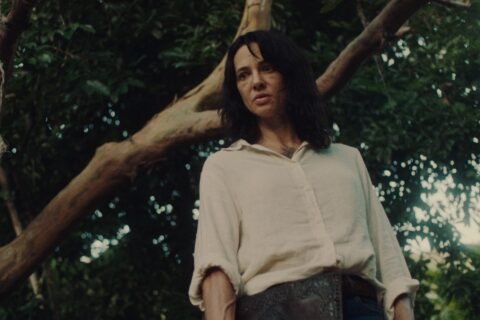
A messy yet engaging drama that traffics in clichés and themes explored more elegantly in other films, Jorge Thielen Armand’s third feature, Death Has No Master (2026), stars Asia Argento as Carolina, an heiress who returns to Venezuela to claim her father’s decaying cacao plantation — only to find herself locked in conflict with the staff who refuse to leave.
The film takes on heavy topics — colonialism, racism, class tension, unresolved trauma, and a country scarred by violence and political upheaval — but doesn’t always handle them with the nuance they deserve. Still, it opens on a powerfully ominous note that never lets up. A masked man orders Carolina to finish off a man bleeding profusely on the ground. From above, Carolina watches herself as he screams in agony and raises a silver sword. A memory? A hallucination? The film pushes forward without explanation.
The sense of dread deepens as Carolina rides in the back of a fierce vintage coupe toward the plantation, first stopping to collect the deed from Roque (Jorge Thielen Hedderich), a family friend/former lawyer. After a tense police checkpoint where she’s forced to pay a bribe, it becomes clear this is no longer the Venezuela she once knew. Vittorio Giampietro’s score amplifies the ick with a droning, rising-and-falling horn motif. As the opening credits roll, the camera follows the car from behind as it drives deeper and deeper into the jungle.
For a while, Armand leans into the material like a spooky haunted-house film. The old plantation isn’t literally haunted by poltergeists, but, with its peeling paint, creaking timber and the jungle relentlessly pressing in from all sides, it is saturated with violence and lingering trauma that continues to haunt everyone connected to it. Her father’s presence looms large (including a clever fake-out suggesting his ghost has returned), while her mother stares down from a menacing portrait.
Unbeknownst to Carolina, her father’s former housekeeper, Sonia (Dogreika Tovar), has been living on the property since his death with her young son Maiko and another man, charging rent to tenants. This arrangement threatens Carolina’s plans for a quick sale, igniting a tense standoff. Local police make it clear that Sonia has squatter’s rights, and in this tight-knit community, sympathy lies firmly with her. One policewoman sharply clocks Carolina’s colonialist attire: “Those boots. That hat. The only thing you’re missing is a whip.”
It’s a cutting line that perfectly captures the lingering pain and resentment toward wealthy plantation owners and their greedy heirs. Unfortunately, it sets up a scene that immediately veers into unintentional camp. Embracing the colonialist aesthetic, Argento dons the hat, screams at a portrait of her father, and begins furiously cracking a whip in a frenzied emotional outburst. It’s a ridiculous moment that few actresses could pull off — and Argento doesn’t quite manage it either, though it’s hardly her fault.
At this point, Carolina fully transforms from a relatively neutral character into a clear antagonist. She rejects any possibility of compromise, decency or class solidarity, choosing instead to remove Sonia and the others by any means necessary.
The film briefly teases the idea that it might withhold the bloody climax it has been promising since the opening frame. A major act of violence then occurs off-screen, after which the movie briefly drifts into an almost abstract register. In the end, it concludes exactly as it should: with no real winners. In stories about racist colonialist assholes, there rarely are.
Editor-at-large Jared loves movies and lives with Kiki in Berlin.
- Jared Abbott

- Jared Abbott

- Jared Abbott

- Jared Abbott