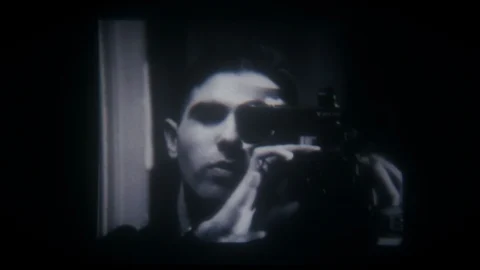
I have turned repeatedly to arthouse cinema and festival films to get away from everyday corporate life and the fast encroachment of AI into every part of my working day. But not only has AI slop infected shopfronts and WhatsApp messages, memes and Substack newsletters, it has also reached the upper echelons of A-List Film Festivals, such as Locarno, where Asphalt Guerilla (Edgar Pêra, 2026) premieres, proudly integrating AI images into its “real story based on surreal facts.” There is no escape, it seems. Artificial Intelligence is the future of everything.
It helps, of course, that Edgar Pêra, who has been making images since the 1980s, although perhaps not a household name, remains an auteur; not just reproducing the ugliness of the machine algorithm for its own sake, but interrogating it through dense and elaborate image-making.
Yet, its use in his latest film — a hybrid documentary about the legacy of April 25th, the overthrow of Portugal’s far-right regime, and the rise of FP 25 de Abril, a far-left terrorist group that posited that the fascists still lived among us — raises all kinds of uneasy questions about its easier-than-ever deployment; at once, allowing low-budget filmmakers to create images hitherto far out of their budget, while also delving us deeper into the uncanny valley, where the line between reality and outright fiction is further blurred, leading to confusion among the populace. One can argue that Pêra is, perhaps like Radu Jude in his scabrous Dracula (2025), using it for good. But what’s stopping the next filmmaker from using it for more nefarious means?
If his frantic, fast-cutting film, freely mixing AI and archival footage, real takes and fakes, metafictional conceits and Godardesque typefaces, has a centre, it is that idea of a bank robbery; revisited again and again. We notice the stained-glass windows in the bank building, as if to show that our understanding of reality is always quite literally coloured by our perception, how it is created and presented to the audience, and how easily that can be manipulated. The first scene, scored to Suicide’s “Ghost Rider” (1977), the ultimate anthem of dissatisfaction captured within perpetual forward motion, is a real Hollywood-esque chase scene, imagining a far different movie from the one to follow.
These bank robbers are the FP-25, a group formed due to dissatisfaction with the unmet aims of the Carnation Revolution, which deposed 50 years of fascism. They believed that the new Portuguese government failed to meet the needs of the revolution, and embarked on a series of robberies and killings; they are responsible for scores of deaths over a seven-year period. This story is complemented by what appears to be Pêra’s own journey as a filmmaker that took the punk ideals of the 80s, revisiting his own footage alongside janky and weird AI recreations.
The final result is manic and dense, a complicated association of ideas and images that rarely slows down to let you figure out what it is all about. While by the end the use of AI becomes bleedingly obvious, and Pêra, although evidently very much enjoying his prompting sessions, links its usage to a new type of techno-fascism, betraying the ideals of his former ecological, artistic and spiritual collaborator Terence McKenna, it is the more subtle uses throughout the film that call into question the very essence and ethos of documentary filmmaking. With no offence meant, it is unlikely Pêras’ film will reach a wider audience, but what is stopping a big Netflix movie or widely-released documentary from slipping in an AI image or two into their otherwise truthful documentary, and us being none the wiser? What does that mean for the integrity of the image, which is supposed to be, as Godard said, “truth twenty-four times per second?”
It is good to see the EU introducing labels for AI-produced content, yet a more comprehensive, internationalist effort must be made among documentary filmmakers to ensure that the user is never conned by models that are drastically, and terrifyingly improving with every single iteration. One can assume that Pêra’s heart and ideas are in the right place. But with this technology so freely available, and cheap to use, and growing ever-closer to indistinguishable from truth, what is stopping a bad actor from manipulating the archive to suit their malicious ends? The world simply seems completely unprepared for the horrors of the present moment.
Redmond is the editor-in-chief of Journey Into Cinema.
- Redmond Bacon

- Redmond Bacon

- Redmond Bacon

- Redmond Bacon