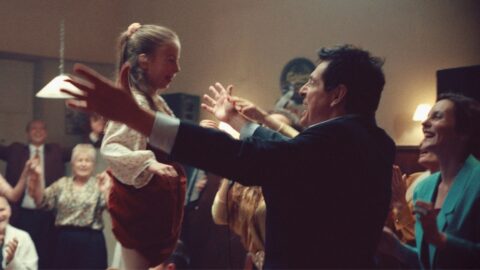
Damning any chance of Google discoverability to hell, naming this film the one-syllable Home (Marijana Janković, 2026) slowly reveals itself to be more imaginative than it initially appears. When the Big Screen entry starts, we get it in Cyrillic, дом; as it ends, the title transforms into the Danish Hjem. In the 100 minutes between both titles, we see how the idea of Home transforms: from a romantic pre-war ideal to a deep and lingering modern sadness; one comprised of compromises, broken promises and a family rent apart by the unavoidable forces of history.
At its heart is Marko (Dejan Čukić), a passionate family man governed by a simple ideal: that hard work should result in a comfortable life. But in Yugoslavia at the onset of brutal civil war, finding good money in exchange for labour seems more precarious than ever. It doesn’t help that Marko — ostensibly, a good and caring man — is bitterly stubborn; in a telling early scene, he refuses to lower the price of raspberries in a market, even if it means making no sale at all. He wants to do things the right way, even if it leads to further hardship.
This scene gives us a way to read the rest of the decisions Marko makes along the way, attempting to help his family in economic terms but actually pushing people further away. So, when his uncle (the ever-reliable Danish-Croatian actor Zlatko Burić, whose presence seems obligatory in any Scandi-Balkan film) appears from Denmark, and espouses the promises of the northern nation, we can see many possible red flags emerging upon the horizon.
Still, Marko decides to join him on his return, bringing his wife, Vera (Nada Šargin) and 5-year-old daughter Maja (Tara Čubrilo) along with him. But his sister’s flat in Copenhagen doesn’t have space for his two sons, leading to the heartbreaking decision to leave them behind with their grandmother.
Perhaps the film could’ve been more fascinating had it tracked the dual destinies of the boys and the young Maja, but the lads remain something of a lost spectre, haunting the well-meaning Marko as he fails to integrate into Danish society, and lives in fear of immigration services, even as his daughter, young as she is, finds herself quickly adopting a more Scandi way of living. The best scenes in the movie show how Marko is transformed by his foreignness in Denmark from a smart, well-meaning man into a simple immigrant, tragically hampered by his lack of language skills and inability to navigate Danish niceties. The film is brave enough not only to explore the issues of migration and assimilation from a societal perspective, but to ask how much responsibility rests upon those who do migrate to make a proper effort to get involved in society, rather than assuming everything is going to be the same as back home.
Janković’s feature debut is handsomely-mounted in widescreen, with close-up shots, plenty of shallow focus, great panoramas of the Balkan countryside and fine acting performances — with notable cameos from Danish stalwarts Claes Bang and Trine Dyrholm — giving us an emotionally astute drama that lacks enough genuine conflict to force the viewer into proper emotional identification with its characters. There’s little to truly criticise here, but nothing much that kept me truly involved either. In essence, a quintessentially Danish film at Rotterdam.
Particularly strange is Burić’s role, disappearing after the first act until almost near the end of the movie. The enigmatic, seemingly well-off Uncle could’ve been a powerful presence, especially with an actor of Burić’s stature, but his misuse encapsulates Home’s flaws quite powerfully: avoiding the chance for dramatic fireworks in favour of more muted squibs instead.
Redmond is the editor-in-chief of Journey Into Cinema.
- Redmond Bacon

- Redmond Bacon

- Redmond Bacon

- Redmond Bacon