The first time I visited Almería, down in Andalusia, southern Spain, I was floored and kind of unsettled at the same time.
The landscape is unreal — rugged coast where desert slams right into mountains, with some of the most beautiful beaches in Europe just a short drive away, like Cabo de Gata. But then you see it: this endless sprawl of white plastic greenhouses covering everything, shimmering in the heat like a giant synthetic tarp stretched over the whole terrain. The place has been totally remade for export — ecosystems pushed to the limit, the people doing the work mostly invisible and underpaid — so the rest of the world can have cheap tomatoes and peppers all year round. From thousands of miles away, it’s easy to shrug off; standing in the middle of it, you can’t look away.
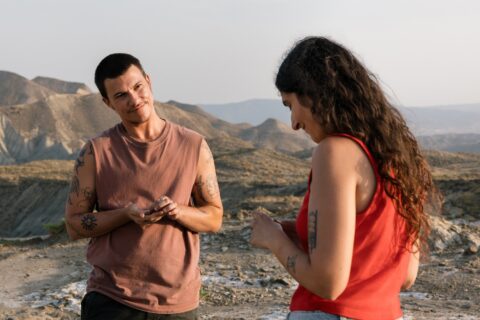
Ian de la Rosa’s new drama Iván & Hadoum (2026) takes place right there in that world. It follows two people who grew up in this place and now carry its weight in totally different ways. Iván (Silver Chicón), a trans guy, works in one of those massive industrial greenhouses owned by family friends. The job’s reliable, and he’s pushing for a promotion — not because he’s dying to climb the ladder, but because he needs to get his big extended family into a better place to live. Early on he meets Hadoum (Herminia Loh), a Moroccan woman who grew up in the area, starting her first day as a fruit/vegetable packer. She gets hurt by a forklift almost immediately. The manager offers to send her to a doctor; she turns it down flat — a survival-shaped instinct she ends up wishing she hadn’t listened to. That choice basically sets the whole tone. From there, the film builds this careful, hesitant romance while never letting you forget the brutal labour system and the grinding machinery of European capitalism underneath it all.
It’s clear both of them have experienced bigotry related to their identities — both little digs and outright hostility — but the movie never reduces them to victims. De la Rosa shows the prejudice they face without making them helpless. There’s an early scene at a bar where Hadoum is singing karaoke, and the bartender abruptly cuts her mic. Iván steps in, and things escalate fast. The bartender snarls something about “no Moroccan telling me what to do,” then pivots and calls Iván a “hybrid.” Iván doesn’t flinch. Voices rise, a fight erupts off-screen — we don’t see the blows, but it’s crystal clear these two aren’t going to just take it.
The rest of the story follows their fragile, tense relationship, but it’s never only about the romance. The outside pressure never lets up, and de la Rosa keeps the focus mainly on labour and power. Things get heavier when Iván gets bumped up to line manager, and heavier still when a bigger promotion dangles in front of him. Everyone — the bosses, even parts of his own family — knows the workers are fed up, maybe gearing up for a strike or planning to mess with an audit that could kill a big sale. They’re all nervous that Iván could be getting too close to the workers — they all expect a firm dividing line in the power structure. The question keeps hanging there: will he side with the people on the floor, with Hadoum, or cross the line and become the guy who looks the other way while the “little people” get screwed?
De la Rosa’s script holds this tension throughout, never spelling everything out for the audience. There’s a lot of history between the characters — especially Iván, his family, and the greenhouse owner’s family, along with his deceased father’s role in it all — but we learn it in small, deliberate pieces. Hadoum’s past is also explored, revealing a restless, weary soul who wants more than Almeria has to offer. There’s a nice, deliberate yet natural pace to the way things develop, putting both of its characters in tough situations that feel grounded in reality.
Beatriz Sastre’s cinematography complements this perfectly. She favors handheld cameras and close-ups, capturing intimacy blooming amid pressure and uncertainty. Several scenes showcase her work at its most dazzling: a lovemaking scene in the greenhouse, shot through an infrared lens, and a carnival sequence where Iván and Hadoum have a key conversation in a funhouse. The mirrors distort their faces and bodies, twisting the image in a way that reflects the tensions pulling them in different directions.
It’s a small, quiet film, one that surprises in many ways — mostly because it has so much on its plate and never really buckles under the weight of its many topics and tensions. It’s buoyed by strong performances from two newcomers who bring both tenderness and grit to their roles, and by a sensibility that trusts its audience to put pieces of the past together themselves. And while its message about not making deals with the capitalist devil is always welcome — you’ll probably get screwed in the end — the film goes further: it shows how those deals can potentially force you to fuck over the people you care about most.
Editor-at-large Jared loves movies and lives with Kiki in Berlin.
- Jared Abbott

- Jared Abbott

- Jared Abbott

- Jared Abbott