In an era when many young men are increasingly alienated and emotionally disfigured by toxic online discourses — manosphere influencers, pickup artist content, and pornography that marginalises women’s agency and pleasure — there remains a pressing need for narratives that centre young women’s subjective experiences with nuance and authenticity. Fernanda Tovar’s debut feature, Sad Girlz (2026), emerges as both timely and essential in this regard.
Premiering in the Generation section, Tovar’s film unfolds in the aftermath of a sexual assault at a New Year’s Eve party. Rather than dramatising the event itself, she situates the story in the suspended stretch that follows — the uneasy space between a violation and the victim’s decision to report it, confront it, or simply try to live alongside it in silence. In contrast to the more overtly graphic and confrontational 17 (Kosara Mitic), another Berlinale entry addressing teenage girls and sexual violence, Chicas Tristes is quieter, more introspective and ultimately more destabilising. It asks the hardest question: what happens next?
The Mexican film opens by establishing the intimate bond between two sixteen-year-olds, Paula (Darana Alvarez) and La Maestra (Rocio Guzman). They share easy companionship — lounging around the apartment block, exchanging gossip about boys, taking selfies, and training rigorously with their swim team ahead of an international meet in Brazil. Tovar captures the cadences of adolescent friendship with ease; the two protagonists feel like you’re watching two friends IRL.
At the New Year’s party, Paula finds herself alone in a bathroom with Daniel, the teammate she’s been crushing on. La Maestra sets it in motion by letting Daniel know that Paula is into him. The assault is never visualised. This deliberate omission stands as one of Tovar’s most consequential choices. By refusing to reenact the violence, the film avoids gratuitous imagery and instead foregrounds the lingering emotional repercussions: Paula’s gradual withdrawal, the subtle shifts in her posture and demeanour, her hesitation to open up to her best friend. These nonverbal cues convey the trauma long before words become possible. Tovar demonstrates a keen understanding of adolescent communication — of what remains unspoken, even between closest friends, and how language may take days or longer to emerge.
The anguish of Paula’s situation is compounded by the fact that Daniel is not portrayed as a monster. He is an ordinary boy she once liked, a familiar presence on the swim team. When he later attempts to reconnect casually, as if nothing irreparable has occurred, the resulting disorientation deepens. Tovar resists centring him in the narrative while also declining to reduce him to cartoonish evil. The film confronts an uncomfortable reality: sexual violence frequently involves someone known and trusted, and the perpetrator may fail — or refuse — to recognise the gravity of his actions.
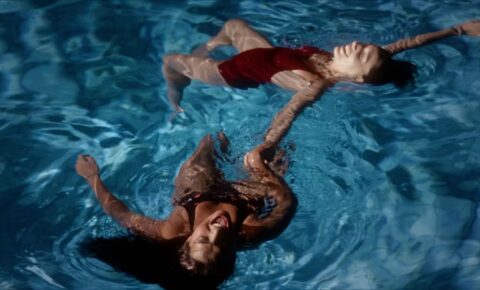
The swim team itself becomes a potent site of irony. The pool and its serene cerulean tones continue to serve as a sanctuary for Paula and La Maestra. Underwater sequences are luminous and meditative, evoking a suspended tranquillity amid submerged bodies — a space of discipline, camaraderie and escape. Yet it is also the shared environment with the boy who assaulted her. This duality — refuge and violation coexisting in the same physical space — encapsulates the film’s emotional sophistication. Trauma does not immediately sever one from beloved places; at times, it demands continued presence within them.
Up until the final stretch, adults hover mostly at the margins. Yet this is not a lurid panic in the mode of Larry Clark (“It’s 10pm — do you know where your kids are?”). These feel like ordinary working-class kids, likely raised by single parents clocking long hours. In one painfully contemporary moment, La Maestra turns to ChatGPT for advice on how to support Paula after the assault. The gesture is both touching and devastating — a teenager outsourcing emotional labour to AI because she doesn’t know who else she can discuss it with. And their swim coach delivers a tangle of mixed messages, a sort of “it’s your duty to report a crime… but also, consider what that might mean for the team’s trip to Brazil.” In other words, don’t rock the boat.
Visually, Chicas Tristes maintains a laid-back, almost hangout-movie atmosphere. Sunlight floods the frame during long afternoons on the rooftop. A moment of synthetic escape — an LSD trip that briefly alters reality — suggests the girls’ desire to float free of the heaviness pressing in on them. That tonal lightness is not a contradiction but a strategy. Life does not dim its colours just because something violent has happened.
What renders Chicas Tristes truly resonant is its rejection of facile resolution. The film lingers on the incremental, agonising negotiations — whether to report, whom to confide in, and later, how to handle a small breakdown of trust from your best friend. Amid a Berlinale program with exploitative explorations of sex, power and entitlement (as in certain entries in Perspectives and Competition), Tovar’s restraint feels radical. The film listens attentively to the interior worlds of teenage girls and trusts their complexity. In doing so, Fernanda Tovar establishes herself as a filmmaker of considerable sensitivity and insight. Can’t wait to see what she does next.
Editor-at-large Jared loves movies and lives with Kiki in Berlin.
- Jared Abbott

- Jared Abbott

- Jared Abbott

- Jared Abbott