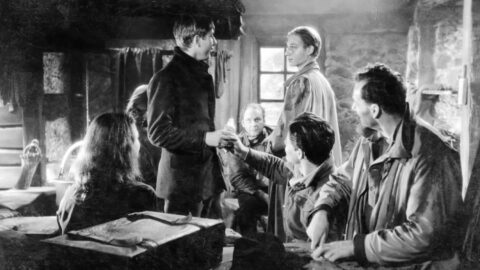
The Last Chance (Leopold Lindtberg, 1945) starts with one of my favourite tropes, later perfected in The Hidden Fortress (Akira Kurosawa, 1958) and copied by Star Wars (George Lucas, 1977): two small figures, caught in the middle of a long war, eventually find themselves swallowed up in something much larger than themselves. I like it so much because it gives us a relatable way in to the drama, the idea that we too could be, under the right circumstances, swept along in the grand tides of history. But The Last Chance — which played in the very first Karlovy Vary and even won the Grand Prix du Festival International du Film (now known as the Palme d’Or) at Cannes1It’s worth pointing out that ELEVEN films, including Brief Encounter (David Lean, 1945), Rome, Open City (Roberto Rossellini, 1945) and The Lost Weekend (Billy Wilder, 1945), tied for first prize in the festival’s inaugural year. — is more didactic than its successors, imagining that, although history is unstoppable, with the right choices, we could make an impact, however small it might be.
These two men are the British Lieutenant John Halliday (John Hoy) and the American Jim Braddock (Ray Reagan), who, in a thrilling opening sequence, escape from a bombed train bound from Italy to Innsbruck somewhere in the Alps. In the opening third or so, they evade the Italian authorities, relying on the kindness of strangers as they make it to the lake crossing. But they fail to pass and somewhere in the mountains, they come across a group of Jewish refugees, and alongside the extremely British Major Telford (Ewart G. Morrison), they shepherd them through the mountains into neutral Switzerland.
Shot with real soldiers (the two Brits were prisoners of war; the American’s plane crashed in Switzerland), this rousing Swiss war drama gets great mileage out of the three leads, who excel, of course, in playing versions of themselves, with all that pain and baggage that comes from having been on the frontlines. Despite the Hollywood-esque flash of the script, the bluntness of its message and the broadness of acting choices, it lends a certain verisimilitude to the film that gives it its strong emotional power.
I’m not usually one for keep calm carry on propaganda, the idea that British composure and resourcefulness meant we were uniquely equipped to bash the Jerries, etc, etc, but there is something rather elegant and powerful about the way that these Brits (and one American) decide to lay their lives on the line in service of something greater than themselves, rarely losing their heads as they do so. In conjunction with Romano Calò’s dignified performance as a priest doing his utmost to ensure safe passage, it reminds us that these jobs — whether liturgical or military — are supposed to be dedicated to service. Seeing them carried out with such dignity is a thrilling fantasy, a throwback to unambiguous goodness in a world so rent with evil.
Filmed during the tail end of WW2 and making use of real locations — as well as the novel sight of Nazis on skis — The Last Chance is filled with a deep sense of urgency that individuals in Europe must act, in any way they can, to protect refugees, particularly Jews, whenever they get a chance. With refugees still scattered throughout the continent thanks to wars in Ukraine, Syria, Afghanistan, Sudan, Palestine, and many other countries, this message seems to ring truer than ever, as does the idea that any man, even the most insignificant-seeming, can do his part to fight for freedom of movement. In a terrible, cynical world, this moral clarity feels deeply refreshing.
Redmond is the editor-in-chief of Journey Into Cinema.
- Redmond Bacon

- Redmond Bacon

- Redmond Bacon
- Redmond Bacon