I was seven years old when America invaded Afghanistan. I am thirty-one years old now, and America is bombing Iran.
Despite the fact that American interventions in the Middle East almost always result in mass murder, displacement and more terrorist radicalisation, the United States of America, largely supported by its allies in NATO (although not with complete alignment this time, I guess), keeps on making the same mistakes while expecting the same results, which is, as the maxim goes, the very definition of insanity.
The lizard-brained among the right might say look this time is different, this time it will work, the Iranians are not like the Arabs, or claim that, like in Iraq, they need to invade to protect the West from nuclear weapons (sure), but these voices, like in 2001 or 2003, are not even worth an intelligent response. These are people who relish the theatre of war and fetishise American military might (propagated in film after film), giving little thought to the people of these nations who are left to deal with living in a broken society.
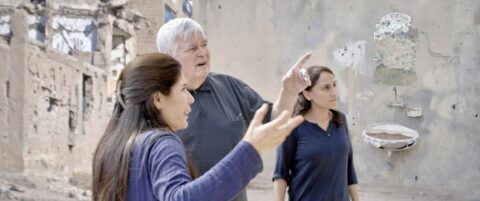
Enter the German TV journalist Ulrich Tilgner, who has been a mainstay of political consciousness for decades, reporting on conflicts across the Middle East for ZDF, Deutsche Welle and ARD. He is followed by the inquisitive Swiss director Edgar Hagen for The Roots of Madness (2026), a compelling tour of destroyed West Asian societies through the eyes of the man who has seen it all before.
With bright white hair and sunken eyes, the septuagenarian Tilgner maintains his journalistic enthusiasm even as his humanistic worldview has been battered by repeated disappointments. From Afghanistan to Iraq to Syria, even Niger, we follow the diseased spread of hollow military interventions, seeing how they breed more misery while ignoring the genuine needs of the people they claim to liberate.
I really appreciated the nuances of the criticisms here, looking not only at how the Americans repeatedly contravened the principles of international law in their wars of aggression — especially in Fallujah, Iraq, where they used phosphorus on citizens — but also how, once they had achieved domination, they had no clear plan for the transition of government. Dictators are replaced by thieves, strongmen by Islamic terrorists, and the common man is left jobless, living in a refugee camp or resorting to crime just to feed his family. (This is supported by the numbers. In Afghanistan, Hagen claims, for every dollar spent on rebuilding Afghanistan, 60 was spent on waging war, adding up to a mind-boggling two trillion dollars in total.)
Besides brief clips of Colin Powell and Hilary Clinton, the most refreshing thing is the complete absence of American voices. We’ve heard the equivocations, the lies, the flag-waving clichés far too many times; it’s time to let Muslim voices speak instead, to tell us in their own words how they are struggling, why this happened and the genuine ways that the international community could help.
We also see, almost Adam Curtis-like, how all these struggles are deeply interwoven. Take the question of Rojava, an autonomous region of north-eastern Syria, run by the Kurds. Having successfully pushed back against the Islamic State, they face almost daily drone bombings by the Turks. Turkey is a member of NATO, yet their actions against the Kurds (who the Americans ostensibly support) are tacitly accepted, because Turkey (bordering Iran, Iraq and Syria) is the first bulwark against the European refugee crisis — which, of course, was largely caused by Western intervention by the West in the first place!
The rabbit hole goes deep, the connections between Europe, USA, Africa and the Middle East (Russia and China are curiously elided here, possibly for brevity and clarity of vision), extensive and vastly complicated, affecting hundreds of millions of poor Muslim people who simply can’t seem to get a break. Hagen’s excellent film lays this out with moving aplomb.
Except for one crucial, almost fatal, caveat. The Israeli genocide in Gaza — abetted by American money, influence and even soldiers serving in the IDF — is completely neglected, reflecting a reticence on behalf of Central European countries, German-speaking in particular, to say anything negative about Bibi’s bloodthirsty regime out of an absurd fear of being painted antisemitic. Without mentioning the struggle of the Palestinian (or Lebanese, come to think of it) people at all — not even in passing (all the more puzzling as Tilgner himself has spoken on this issue) — the film feels incomplete. Palestine is not a separate part of the Arab struggle. In many ways, it epitomises it. Its absence is baffling.
Redmond is the editor-in-chief of Journey Into Cinema.
- Redmond Bacon

- Redmond Bacon

- Redmond Bacon

- Redmond Bacon