Sasha Svirsky is truly a one-of-a-kind animator and a real highlight whenever his films premiere at the Berlinale. Characterised by a manic, freewheeling energy and a penchant for the absurd, works like My Galactic Twin Galaction (2020) and Vadim on a Walk (2021) beguile with their terminally online aesthetics, like listening to vaporwave while scrolling through a troll feed on Instagram.
His latest, Unidentified Nonflying Objects (UNO) (2026), playing once again in the Shorts competition, is further proof of a style perfectly suited to today’s eternal feed: a man’s journey through bureaucracy, work alienation and a world filled with endless, unsortable information.
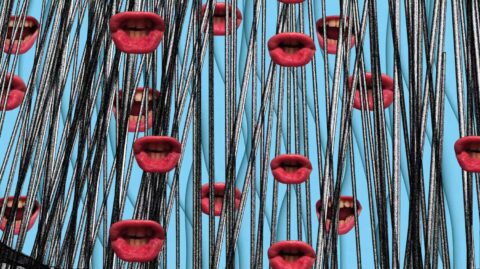
Suitably narrated in German but with a heavy, knowingly stereotypical Eastern European accent, Svirsky’s character, working for a company tasked with sorting these UNOs, attempts an exhaustive cataloguing of these objects: their features, their identity, their instability, their colour. As these objects are unidentified, we never quite know what they are, reflected in an animation style (created in Blender and Krita) that blends 3D computer graphics with hand-drawn pencil work, Monty Pythonesque collage and live-action images, all complemented by Alexey Zelensky’s loopy, unclassifiable electro score.
Despite these things being unknown, they are still processed by a vast machine of knowledge, which brings to mind the rise of Artificial Intelligence, trained on models that we don’t properly understand, creating a world that is simply impossible to comprehend. Yet, while Svirsky’s work feels in tune with meme culture, the uniqueness of his vision, its blend of silliness and provocative imagery (particularly unsettling is the use of real images of eyes and lips in a cartoonish setting), its chaos and grid-like organisation, and its old-school charm still resist the pathetic smoothness and sameness of AI imagery. Only one man could make this — it’s a true pleasure to experience his vision.
Redmond is the editor-in-chief of Journey Into Cinema.
- Redmond Bacon

- Redmond Bacon

- Redmond Bacon
- Redmond Bacon