The world may be a vast, unquantifiable place, with great differences in landscape and ways of life, yet there is one thing that unites us all: the encroaching threat of climate change. It’s a theme that the globe-trotting documentary We Have To Survive (Tomáš Krupa), playing in Open Horizons, stresses with its symphonic approach, contrasting four very distinct habitats — North Carolina beachland, the Australian desert, Greenland and rural Mongolia — to show how there’s no escape for humanity from rising temperatures, floods and more frequent, more intense natural disasters.
I’d say at this point, looking at the current crop of leaders, there’s not much we can do to prevent climate disaster from happening. It’s already here, and it’s already wreaking damage. The focus should be on adaptation, in the hope that, just somehow, enough can be achieved to keep the human project viable.
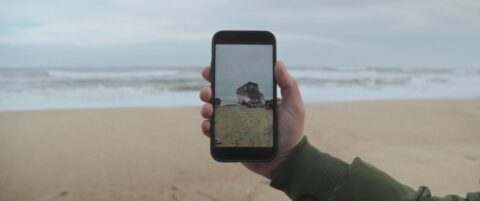
As far as climate documentaries go, We Have to Survive avoids both dramatic statements and angry polemic, offering a more contemplative, observational mood as Krupa criss-crosses the globe to see how people are adapting to the new normal. We begin in the Outer Banks of North Carolina, a series of islands that have long been a favourable holiday destination, but now face the stark reality of seahouses — built on stilts — sinking into the ocean. In one powerful scene, a clip on a phone of a house melting away is displayed in front of the very location it happened — showing how every dramatic scene we see on the internet of environmental destruction is tethered to a lived-in reality.
The same goes for the underground houses of Coober Pedy, central Australia, built into the rock to escape from the temperatures that can rise over 50 degrees. These hermit-like houses are striking both in their sandstone structures and their normality, as if they are a dispatch from a future science-fiction world. But perhaps this type of house is the future? Additionally, as one resident points out, it keeps the temperature at 22 degrees all year round, reducing the need for any heating whatsoever.
These fantastic houses are the most interesting part of the film, and merited a documentary all of its own, perhaps akin to Garagenvolk (Natalija Yefimkina, 2020). That film was shot entirely in people’s garages, with many burrowing underground, mostly without permits, building vast spaces that reflected their unique spirit.1Another good comparison is Ulrich Seidl’s In The Basement (2014), which is a true masterpiece of the bizarre. I would’ve loved to have seen something similar with the Australians here.
It’s certainly more compelling than the Mongolian or Greenland sequences, which, although touching in the way they show how both peoples respond to a worsening climate, lack a similar sense of the surreal. Still, the film poses a key, existential question: whether these measures are proof of humanity’s indomitable spirit, or merely, as one Carolinian puts it, like treating a bullet wound with a band-aid?
It’s the perfect mode for educational videos. You can almost see the geography teacher pausing and asking students the difference between adaptation and mitigation. But it perhaps lacks the urgency, borne through a laidback aesthetic, that the genre demands. Stabs at a more rigorous approach — drone shots, montages to classical music — lack the same cohesiveness as its portraiture, resulting in a film that is certainly thought-provoking, but without that powerful artistic centre to truly draw the viewer in.
Redmond is the editor-in-chief of Journey Into Cinema.
- Redmond Bacon

- Redmond Bacon

- Redmond Bacon
- Redmond Bacon