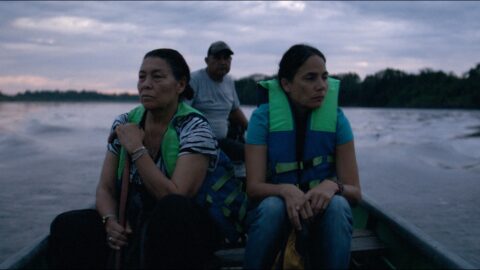
A quiet sense of sadness permeates every frame of Five Years, Four Months (Juan Miguel Gelacio and Esteban Hoyos García), detailing a mother’s unending search for her son, who disappeared during Colombia’s brutal armed conflict. Operating with maximal restraint, this second feature from the directing duo is a touching, almost structuralist experience, capturing the dogged determination of mothers who never give up, despite the apparent fruitlessness of their attempts.
The excellent Jenny Nava stars as Martha Baquero, embodying every scene with a dignified desperation, capturing years of heartache and pain with facial expressions alone. We begin with her digging in a mass grave, looking for traces of her son amidst the many buried, but she finds no luck. She knows there is no chance he is alive, yet all she wants is to find his body; the lack of closure is eating her alive.
So when she bumps into the much-older Sandra (Carmiña Martínez), who has been searching for her son for twenty-four years, and claims to know someone far away who might be able to help her, she sets off on a quixotic quest, deep into the Colombian countryside, in a journey that toes the line between the banal and the mythical, the profound and the savagely dark.
This is a slow-burn adventure, less that of epic myth and closer to structuralist cinema, more attuned to the granular details of movement than anything particularly intrepid. Much time is given to those in-between places, like bus stations and motorways, captured in dark and melancholy tones, the sense of life going on, uncaringly, dispassionately contrasted against Martha’s search.
Heavy shadows and limited lights abound, as if Marthe is groping through the darkness with little more than a box of wet matches, clutching onto old wives’ tales and rumours in lieu of any true institutional efforts. By showing how everyday women have turned into investigators, the film becomes pointedly political, examining the gaping hole left behind by a failing state. And with around 200,000 people still unaccounted for, this shame strikes deep at the heart of the Colombian government, seemingly unequipped to give these women the closure they deserve.
As the film progresses, we can see how issues of exploitation can arise, with Marthe’s journey perhaps the ultimate exercise in folly. Nonetheless, her determination reminds us that the search itself is a form of grieving, a way to keep the memory of her son alive, even as it becomes increasingly apparent that he has long departed. Faithfully portrayed in this small yet powerful film, Gelacio and Garcia pay tribute to the eternal, unbending love of Colombian mothers.
Redmond is the editor-in-chief of Journey Into Cinema.
- Redmond Bacon

- Redmond Bacon

- Redmond Bacon

- Redmond Bacon