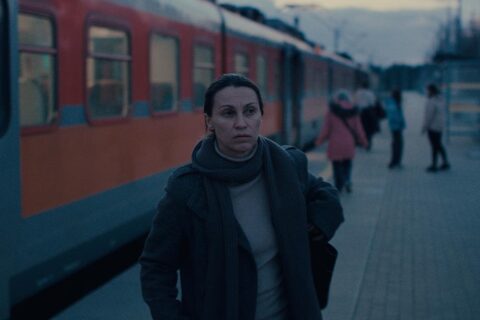
Life really sucks for Kasia (Monika Kwiatkowska), the main character in Grzegorz Dębowski’s second film, What Belongs to Others (2026). She’s stuck with a controlling boyfriend who’s on the run from the police. The two make a living breaking into apartments while pretending to be cleaners. They both look to be in their forties, healthy and perfectly capable of doing the job they’re pretending to do. They could presumably just work as cleaners. Instead, they use the disguise to steal.
That arrangement falls apart when Kasia’s boyfriend is arrested for nicking a bottle of perfume from a supermarket. Left on her own, Kasia falls back on what she knows: she breaks into another apartment, only to find a man hanging from the ceiling. His name is Piotr, and he’s a complete stranger to her. This might cause your average thief to hit the ground running, but not Kasia. She starts taking over his apartment and getting drawn into the life he left behind.
Like Dębowski’s first film, Next to Nothing (2023), What Belongs to Others revolves around a dead body. But here the body is less a mystery to be solved than a doorway into someone else’s life. Kasia starts digging into Piotr’s apartment, his finances, and eventually his family, and the film gradually turns its focus from whether she will get caught to what, exactly, she is looking for in the life of a man she never knew.
What’s immediately noticeable is how little the film tells us about Kasia herself. We meet her already living this way, and Dębowski gives us almost no background. She steals from old people, breaks into homes, and takes the apartment and money of a man who has just killed himself. There is no childhood trauma or buried history waiting to excuse any of it. Dębowski doesn’t particularly ask us to root for Kasia, or even to like her. Her motives remain obscure, and that is part of what makes her interesting. We never quite know what she thinks she deserves, what she is running from, or why she has chosen this life when other options may still be open to her.
There are hints that Dębowski is reaching beyond Kasia’s particular circumstances toward something colder about the Polish society around her. The opening scenes establish this immediately. When Kasia gets kicked out of her sublet, she claims her partner has left her (he hasn’t; he’s hiding in the backyard). The landlady doesn’t give a shit. Maybe she sees through the lie; maybe she simply doesn’t care. What bothers her is the small damage to the flat. Kasia begs to stay and asks, “What should I do? Kill myself?” The woman answers, “Not in my apartment, please.” It’s a nasty, blunt exchange, but it tells us something about the world Kasia inhabits. Vulnerability is met with suspicion rather than help; another person’s suffering comes second to protecting your own property and comfort. Whatever you make of Kasia’s lies and thefts, it is hard to miss how little generosity she encounters in return.
Dębowski shoots all of this in a stripped-down social-realist style: handheld camerawork, naturalistic lighting, and a camera that stays close to Kasia without ever quite getting inside her head. None of it is especially new. There is something almost familiar to the point of exhaustion about this particular European mode of social realism, with its shaky camera, cramped interiors, stairwells, and insistence on keeping everything at street level. And yet, for this film, the lack of visual polish works. It keeps Kasia’s situation from becoming more dramatic or picturesque than it is, while the camera’s closeness gives us a sense of her without pretending to explain her. It may be a well-worn filmmaking language, but here it feels appropriate: Kasia is watched closely, never quite interpreted for us.
Most of the film unfolds with very little dialogue, which makes Monika Kwiatkowska’s performance especially important. Kasia can seem cold and calculating, treating people as resources, and then a look or a pause will suddenly throw that impression into doubt. Kwiatkowska never pushes these moments into a revelation; they remain small, almost easy to miss. As Kasia becomes more deeply involved in Piotr’s life, the possibility of redemption hangs over the story, but Dębowski is careful not to turn it into a morality play. What matters is whether Kasia can recognise the possibility of another life when it presents itself to her — and whether she even wants one.
Editor-at-large Jared loves movies and lives with Kiki in Berlin.
- Jared Abbott

- Jared Abbott

- Jared Abbott

- Jared Abbott