One Minute to Midnight (Nicolas Pariser, 2026) is not so much a slice-of-life drama as a whisper-of-life drama, a film so breezy and easygoing, despite the seeming seriousness of its subject matter — dealing with the patriarchy, fascism and nostalgia — that it sometimes threatens to tip over into impermanence. While certainly enjoyable for its long conversations and quiet insights, this tale of an early middle-aged man looking back on his life lacks the kind of vital spark that justifies its inclusion in the Venice Competition.
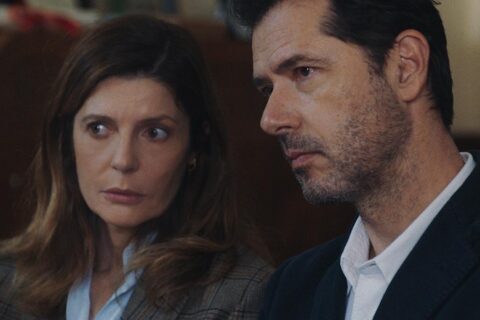
Melvil Poupaud stars as Léo, who finds himself stranded in Paris for a few days between the breakup of a relationship with a woman in Nancy and travelling to Italy to hear his estranged father’s will. In a reflective mood, he takes the time to interact with his magazine buddies and a smattering of past and new lovers, all the while Paris is descending into some kind of obscure authoritarian regime.
The result is a modest character study with a lot on its mind, floating from one conversation to the next, but with little thought to plot development, huge revelations or dramatic confrontations. It’s basically people talking, and it’s very nice to watch. I liked it. But not a lot. Just a very modest amount.
To be fair, if there’s anyone who can walk around Parisian streets looking sad and getting women to feel sorry for him, then it’s Melvil Poupaud, who rarely feels like he’s acting, with that rare everyman ability that feels easy and lived-in. He was, of course, the great star of one of the greatest films ever made, A Summer’s Tale (Éric Rohmer, 1996), featuring a man so indecisive that his inability to commit to one woman takes on perverse, transcendent thrills. His Léo is almost like a grown-up Gaspard, looking back at a life that he failed to take by the horns, and is now regretting the lost time.
Having studied under Rohmer, Pariser has a similar love of long conversations, circling around the battle of the sexes with a peculiarly French adoration for intellectualising romance, politics and sex. But in the post- # MeToo era, the sense of an affair as a kind of fun game for adults is over, with many women both challenging Léo’s previous boorishness — sleeping with interns, not calling out other terrible men, including one now accused of multiple sexual assaults — while refusing to solve his problems for him. The important thing, it seems, is to keep the conversation going, especially as the President threatens to invoke Article 16, granting him dictatorial powers, and riot police are a nonstop sight on the streets.
There is a curious tension here. On the one hand, there are coffee shop conversations, walk-and-talks and immaculately decorated apartments; on the other, France — and the world at large, it seems — is becoming more and more fascist. But this backdrop doesn’t really highlight the themes of the movie. It’s just kind of there, with the plot of Léo’s Gen Z daughter (Clara Pacini) joining the revolution curiously underdeveloped. The film seems to say that if men want to make effective change, they should listen to women, but with all of them willing to give the passive Léo so much time of day, it doesn’t amount to much more than a mere hill of beans. A disappointment, but like Léo’s life, only a minor one.
Redmond is the editor-in-chief of Journey Into Cinema.
- Redmond Bacon

- Redmond Bacon

- Redmond Bacon

- Redmond Bacon