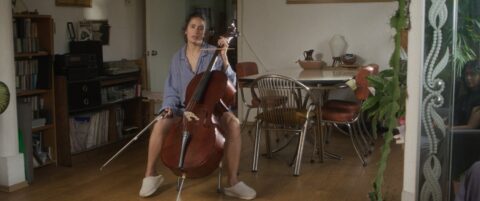
The cello is the most guttural of instruments.
With its low, moaning notes, its range of expression is perfect for capturing an acute sense of distress and melancholy, confusion and discordance. Take the opening scenes of Nicolás Pereda’s excellent Everything Else Is Noise (2026), whereby a Mexican street scene — gridlocked cars, intersecting traffic, the constant hum of beeping and motorcycles weaving through cars — is scored by cumbersome, put-upon tones, giving the tableau a feeling of pent-up frustration and foreboding.
But not everyone is as enamoured with Tere’s (Teresita Sánchez) playing. A neighbour, having just put his baby to sleep, begs her to stop playing, even as a dog constantly shrieks in the background. Somehow, he cannot hear the dog, or his sounds are permissible, whereas Tere’s expression is cast as an unwelcome intrusion on familial harmony.
It sets up the main themes of this slyly feminist chamber piece, which first seems like a formalist, minimalist reverie on the nature of art-making, but slowly reveals itself to be a good-old-fashioned family drama, exploring the women on the peripheries of a male-dominated space. In its generosity yet lack of big gestures, this female-focused classical music film represents the anti-Tár (Todd Field, 2022), lacking the verbosity of Field’s film — or Cate Blanchett’s performance — yet no less piercing in its examination of femininity in composition.
Tere has allowed a female composer friend, Rosa (Rosa Estela Juárez Vargas), to use her light-filled, plant-heavy flat for a TV interview, focussed on her life and work. But when the crew arrives, their production is beset by all manner of problems — the mic doesn’t work, the electricity keeps cutting out, that darned dog is constantly barking. Through long takes, simple compositions and a beautiful use of wide-screen — characterised by a fussy, yet relaxing mise-en-scène — we are truly immersed in the world of these women, making for a metafictional experience that abounds in sly, wry pleasures.
Tere and her friend Rosa aren’t the only composers here. Tere’s daughter, Luisa (Luisa Pardo), whom she had at 17, is also an up-and-coming artist; and her father, and Tere’s estranged ex-lover, is the famous Estevez (José Rodríguez López), far more renowned than any of these women put together. They resent him for both his negligence and his fame, with the man — both condescending and brimming with false arrogance — only arriving at the very end of the film, showing Pereda’s talent for turning a seemingly oddball arthouse dialogue-piece into a tightly-wrought comedy-drama.
But there are some things that we cannot say. That’s what music is for! At the centrepiece is a cello performance by Luisa, which we only see from the perspective of the film crew and the two other women, told to close their eyes so they can focus on the music. It’s best to close your own eyes during this scene too, allowing the experimental, percussive, otherworldly sounds to wash over you. The music says something unique that cannot be put into words — as do the sounds of the city, the gestures between the women and the silences between exchanges. I adored everything Pereda was going for here.
Redmond is the editor-in-chief of Journey Into Cinema.
- Redmond Bacon

- Redmond Bacon

- Redmond Bacon
- Redmond Bacon