In certain Scandinavian countries, apparently, it’s customary for couples to have sex before they decide if they are romantically compatible. But thousands of miles across the world, the country of Indonesia passed a law whereby all forms of premarital sex are completely outlawed. In some places, sex is a trivial thing, to be given up at will; in others, it is close to holiness, only reserved for the most deserving eyes.
In the United States of America, the picture is more heterogeneous — and complicated. The country is vast and varied; I imagine it’s easier to pick up a mate in the streets of Boston than in the Bible Belt. The country is at once home to the biggest porn industry in the world and some of its biggest anti-sex campaigners. The cinema lurches in equally paradoxical directions, spurting out the sexy and complicated films of the 70s and 80s, leading to the erotic thriller boom of the 90s, before the weird gross misogyny of the 00s to the relatively sexless era of today. One only has to look at the goddamn Odyssey (Christopher Nolan, 2026), which lamely scrubbed all the naughty bits out, making Odysseus a mental health warrior rather than a sexual deviant.
What One Night Only (Will Gluck, 2026) — which was presumably pitched to execs as “The Purge (James DeMonaco, 2013) but for sex” — proposes is a society where the puritan spirit has almost completely prevailed. Sex between unmarried couples is now completely verboten, apart from — as we are told about fifteen times in the first ten minutes — a 12-hour window between 7 pm and 7 am that occurs once a year. Blending an unsettling dystopian picture with an upbeat romantic comedy, it captures the paradoxical picture of contemporary America — at once fascinated by sex, yet simultaneously horrified by it.
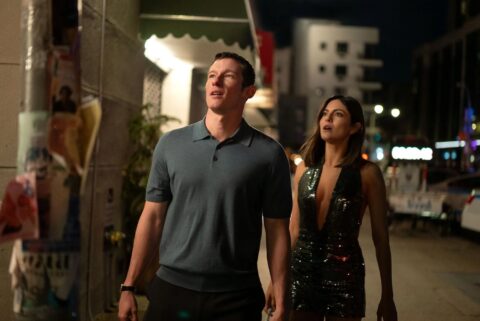
Naturally, in this type of one crazy night comedy — splitting the difference between Blake Edwards’ madcap Blind Date (1987) and the semi-demonic New York-vision of After Hours (Martin Scorsese, 1985) — we must have a couple, and they must have their own differing relationships to sex. There’s Owen (Callum Turner, with a bad Yankee accent that sounds like Chris Evans), who is looking to pop the question to his erstwhile girlfriend before she unceremoniously dumps him for their hot neighbour, and is now back on the streets to stick “his thing” in “anything.”
Then there’s the jingle singer Ally (Monica Barbaro), who is more of a romantic (or we could say, to be woke, demisexual), and needs to have a romantic connection before she decides to sleep with someone. Together, the unlucky couple — whose respective quests for consummation are often scuppered by circumstance, bad timing or psychotic partners — keep crossing paths across the Big Apple, seemingly covering four out of five boroughs in their journey for sexual (and romantic) fulfilment.
The world-building mostly comes through the background — special adverts from K-Y, Durex, even Duolinguo, promoting their products for just one night; state propaganda; anti-government graffiti, etc — with Gluck uneasy to dive deeper into the kind of society that might pass such a drastic law. It’s safe to say that the film seems lightly against such a proposal, but is not particularly interested in opposing it, more using it as window-dressing for a whole bunch of hijinks, and yes, a sappy treatise on so-called true love. 1In fact, one could ask many, many questions about the law in this film. For example, this so-called window seems to discriminate significantly against the one in 10 women who might be having their period at this exact moment. Do they get a different window a bit later? Or are they just completely ignored? Or why don’t people just get married and divorced straight after, like in parts of Islamic culture? And why hasn’t there been an exodus, like during the Vietnam War, to places like Canada, Cuba and Mexico? Are Embassies exemption zones? It almost demands a sequel to flesh out this strange, multifaceted world.
Those expecting a Bacchanalia of flesh and limbs, grasping in desperation, hot, sweaty, and unbearably horny, look away now. The action is curiously tame, geared mostly towards comic payoffs, with none of the free and easy relationship to nudity that we might expect in a European production. There’s plenty of people in their skivies, disappearing into rooms, or glimpsed through windows, but there’s nothing to suggest anything particularly erotic or sensual. And why would there be? This is a Will Gluck film.
It shows that while contemporary American cinema wants to make a movie about sex — especially as people keep complaining that movies don’t have any sex in them, the real naughty stuff having gravitated towards television — it doesn’t want to make a movie with any actual sex in it, resulting in a strangely regressive movie, one that those who may be in favour of such a ban could almost turn to as a reason why.
It’s like that godawful Netflix show Too Hot to Handle (Charlie Bennett, Laura Gibson, 2020-2024), which promises a fun show then ends up being a lame, holding hands lesson. Yes, maybe the Scandis are too much, but there’s no need to say that every hookup should have some big feeling behind it. It’s positively childlike!
It helps that neither Turner nor Barbaro, two conventionally attractive yet rather dull-looking leads, have the charisma to sell us on their sexual urges or the chemistry to make us root for their particular consummation. One yearns for the exquisite vision of Adrian Lyne’s 9 1/2 Weeks (1986), so beautifully shot on the yuppie streets of Chelsea and Soho, with Mickey Rourke and Kim Basinger completely and chaotically obsessed with one another. It’s sad to think that Hollywood has regressed so much since then: alongside The Invite (Olivia Wilde, 2026), an equally smug film that thinks it’s super duper innovative just by mentioning orgies at all!, sex in American movies is on its last legs.





Redmond is the editor-in-chief of Journey Into Cinema.
- Redmond Bacon

- Redmond Bacon

- Redmond Bacon

- Redmond Bacon