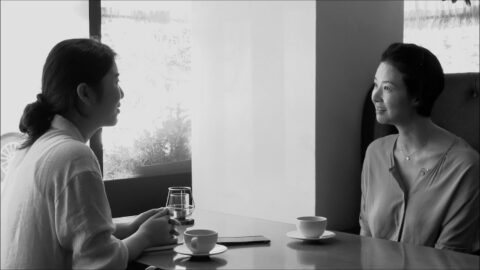
Three interviews in a German restaurant. All shot from the same angle. All the same. It’s always the same with Hong. Same — but different. Like Eric Satie’s Gymnopédies or Cezanne’s paintings of apples, it’s the minor variations that create the interest — and a mysterious source of tension.
While rarely reaching the heights of Hong Sangsoo’s best work1And we would know. We’ve covered SEVEN in the past three and a half years., The Day She Returns (2026) is a slyly pleasurable film, using the format of a press junket to interrogate the performance of self, the impossibility of knowing one’s true feelings, and the way we modulate our behaviour depending on who we are with.
Song Sunmi plays a middle-aged actress. Once a darling of TV and film, she is starring in a new film for the first time in over a decade. She is asked why she picked this film. She says she was drawn to the script; she appreciated its lack of artifice, as seen in popular films, which she compares to being on a rollercoaster ride.
So far, so Hong, with its meta-reflective themes speaking to the Korean auteur’s love of repetition, minimalist ideas — and naval gazing. Yet even by his own standards — plain and pure while never austere or demanding — this is a true poem of simplicity, featuring really long, static takes with only the occasional characteristic zoom. When we see transitions at the restaurant table, it’s to a small beer, or a cup of coffee; drinks are always important in Hong’s movies, with Korean specialities, like Soju and Makgeolli, replaced by the refreshing and clear taste of a small glass of Hofbräuhaus lager.
And the film is entirely in monochrome, which is not so much an aesthetic choice as a way to minimise the glare of sunshine outside, which would’ve been extremely garish if shot in colour.
In recent years, his films have become more and more pared down, with the director-writer also acting as cameraman, sound man and composer; his guitar score is particularly simple, just a few spare chords, yet paired with his pillow shots between chapters, the actress squatting in the grass, having a little vape, they feel oddly apt. Like Satie’s chords, they put us in just that perfectly melancholy yet playful state of contemplation.
It’s a minor exercise in differences. Yet the blurry ending — which I won’t spoil — pulls it all into view (even while pulling us out of focus), synthesising the three convos into an impure, impossible ideal. Can we ever know what we really want to say? Or the perfect way to express our true selves? I guess the meaning is found in the trying, one movie after another, a few small beers at a time.
Redmond is the editor-in-chief of Journey Into Cinema.
- Redmond Bacon

- Redmond Bacon

- Redmond Bacon
- Redmond Bacon