Is art an act of cowardice? In times of war and conflict, what lies behind the decision to turn to theatre and cinema making?
Indeed, they can be a form of resistance, offering moments of connections and consolations in this senseless world. Augusto Boal’s brilliant manifesto, Theatre of the Oppressed (1974), outlines how to promote social and political changes through practices like Forum Theatre and Invisible Theatre. Now at Cannes, many filmmakers voiced that we need cinema now more than ever. But is that the intention behind every artist?
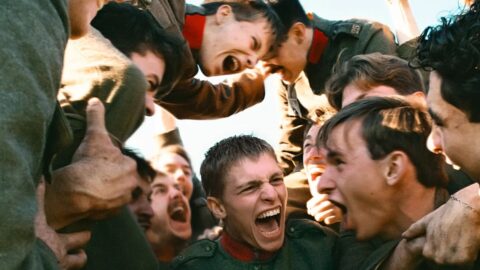
In Coward (Lukas Dhont, 2026), Francis (Valentin Campagne) puts on theatre shows to cheer up his comrades during World War I. Another soldier, Pierre (Emmanuel Macchia), falls for these episodes of liberation, and for the Samuel Barnett-looking Francis. Facing the cruelty of war, Pierre stabs a sword through his own hand to escape all this absurdity, to join the theatre troop to be with Francis.
Bombs going off in the distance, screams piercing through the sky, Francis keeps performing. Blood pouring out in the hospital, people dying in the middle of the show, Francis keeps performing. He says it’s for other people, that these shows are the soldiers’ only escape. Perhaps that was his original intention, but gradually they turn to performing for the generals, entertaining the depraved for a comfortable life.
It gets to the point that Francis even says he doesn’t want the war to end. It becomes clear that he chooses theatre to run away from reality, from the responsibility to help his family’s tailoring business, and from his sexuality. Pierre, on the other hand, tortured by the thought that they are dancing while people are dying, pleads that they elope to the mountains.
We all know how a story like this will end. Francis never wanted to continue with theatre when the war ended, and Pierre only did theatre for Francis. But who are we to judge anyone? Francis is the realist, knowing the world won’t yet accept their love and their actions, that the mountains are a dream that can only exist in drawing. Art making doesn’t always have the purest intentions. It can sometimes simply be a selfish act, or rather an act pre-determined by the time and circumstances.
Ariadne is a film writer specialising in sensory and arthouse cinema.
- Ariadne Si Suo
- Ariadne Si Suo

- Ariadne Si Suo
- Ariadne Si Suo