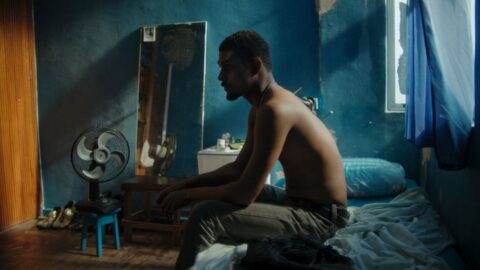
Both premiering at Locarno, Competition entry The Riverbank (Matheus Farias and Enock Carvalho, 2026, feature) and the Piazza Grande-playing Down the Arm of God (Peter Brunner, 2026) turn a fiercely critical eye on Christianity’s role in the United States and Brazil — two countries where increasingly radicalised faith has supercharged political extremism, deepened social divisions and, at times, spilt into outright violence.
Both feel like cinematic responses to the Trump and Bolsonaro years, when each leader drew enthusiastic support from large segments of evangelical communities despite lives and political agendas that often sat uneasily alongside Biblical teachings on humility, honesty and care for the vulnerable.
Down By The River
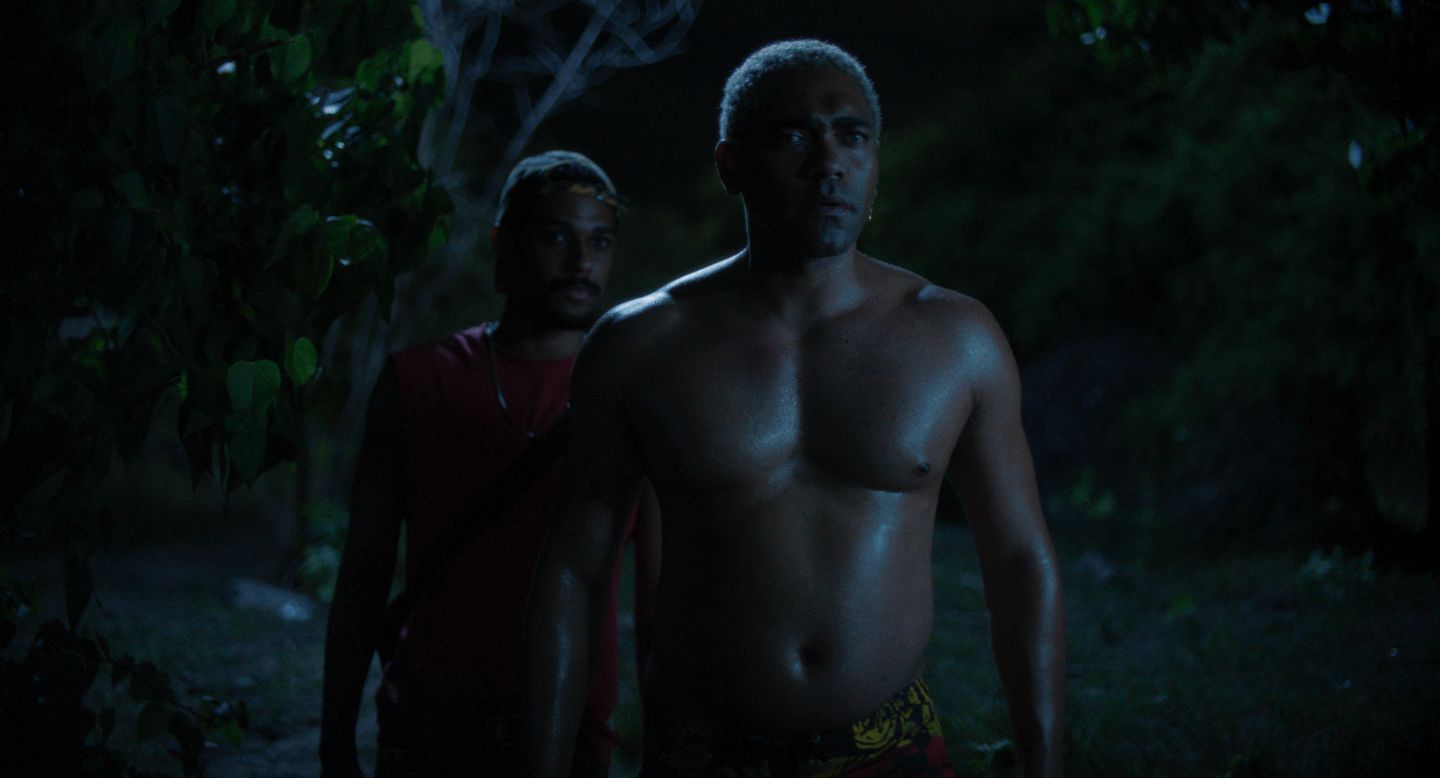
In Farias and Carvalho’s debut The Riverbank, we meet Iziquel (Caique Copque), a young, horny and handsome supermarket cleaner. He gets fired after his boss catches him watching two men hook up by the urinals. Between jobs and still looking for connection, Iziquel spends his nights cruising the mangrove-covered riverbanks, where he meets Jeremias (Ítalo Martins), a local fisherman. Soon afterwards, an employment agency places him at a Pentecostal church run by a charismatic pastor and his ambitious son, a local politician campaigning for reelection. What begins as a simple cleaning job gradually pulls Iziquel into a conservative religious community that preaches purity and deliverance while concealing its own contradictions and appetite for power. Beneath it all lies a murder, while reports of other missing gay men create a constant undercurrent of dread.
The film’s real charge comes from the collision of these worlds: Iziquel’s queer life of cruising, found family, desire and precarious survival rubbing against the church’s machinery of repression, anti-queer politics and gun culture. It feels sharply attuned to Brazil’s recent history, where evangelical fervour and authoritarian politics have fused into something volatile.
The Riverbank is unusual tonally, shifting between erotic thriller, murder mystery, religious drama and tropical noir with touches of magical realism. It’s a little messy, but in a way that keeps you invested, never quite sure where it’s heading. At its best, it lets different communities and belief systems crash into one another without apology: the pious and the non-practising, traditional family and found family, cis and trans experiences, the powerful and the disenfranchised, the erotic and the repressed, the religious and the mythological.
The film also handles its trans characters with real care. Iziquel lives with a close-knit group of trans women who all feel like fully realised people, each with their own desires, frustrations and ways of seeing the world. The actresses — including Artia, Isis Broken and Renna Costa — bring effortless charm and remarkable naturalism to their performances, making the group’s chemistry feel completely lived in. There’s honest friction between them — over sex, money, power and survival — but beneath it lies genuine consideration and solidarity. A standout club scene midway through is pure fire: the dolls performing a song about “tranny chasers” (their words, not mine), voguing hard and having a fierce kiki with the crowd joining in. It’s joyful and defiant, especially when contrasted with the tense, potentially unsafe masc4masc energy of the mangrove cruising spots. That contrast feels painfully authentic, reflecting a tension present in many cities between cis gay male culture and scenes centred around trans and non-binary people.
Farias and Carvalho communicate these ideas as much through atmosphere as narrative, with DP Lucia Bassegio capturing Recife as a living presence. Built across multiple islands and often nicknamed the Venice of Brazil, the city emerges as a place of striking juxtapositions: gleaming high-rises beside favelas, a vibrant queer nightlife existing alongside deeply conservative religious traditions, all connected by rivers that empty into the Atlantic. The camera lingers on humid streets, muddy riverbanks, gaudy church interiors, and dense mangroves with an almost tactile quality, making Recife feel both seductive and quietly threatening.
Water runs through almost every layer of the film, becoming one of its richest visual motifs. It appears in the church where Iziquel works, where baptism promises purification and rebirth, and returns through Jeremias, the fisherman whose life is inseparable from Recife’s rivers and coastline. Without giving away where the story ultimately leads, the film places these different relationships with water in dialogue, suggesting competing ideas of transformation, belonging and salvation.
The measured pacing allows tension to accumulate gradually rather than through sudden shocks, while Caique Copque gives Iziquel a warm, understated vulnerability that makes him compelling even in the quieter moments. The magical realist flourishes emerge organically, deepening the film’s spiritual and political concerns without distracting from its emotional core. Ultimately, The Riverbank asks whether renewal comes through institutional purification or through a deeper connection with the natural world.
Papa Can’t Preach
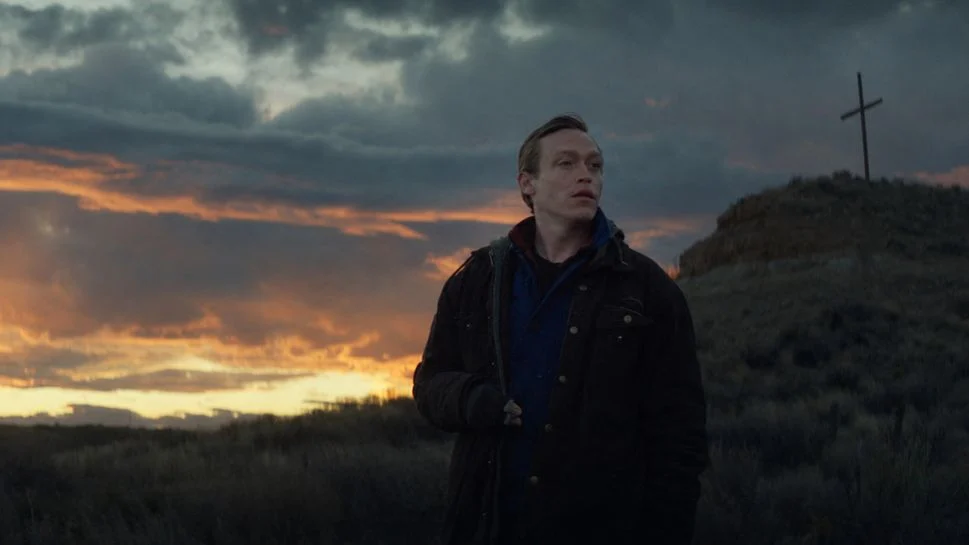
If The Riverbank examines what happens when Christianity becomes entangled with political power, Down the Arm of God turns its gaze elsewhere: toward the believers themselves, and the uncomfortable gap between professing Christ and actually following his teachings. Here, the target is less the Church as an institution than a congregation that has forgotten, or perhaps simply decided to ignore, the parts of the Gospel that demand humility, compassion and care for those an increasingly self-centred American society has left behind. That makes the film feel especially timely in a political moment when figures such as Elon Musk and Gad Saad have increasingly framed empathy as a weakness rather than an essential human virtue. Down the Arm of God offers a pointed counterargument: if empathy is toxic, what exactly is left of Christianity once we remove the obligation to care for our neighbour?
Set in a small Texas town, the film follows Nick (Caleb Landry Jones, also the co-writer), a newly arrived pastor whose attempts to put that obligation into practice quickly put him at odds with his own congregation. When he begins helping the town’s homeless population, first feeding them and then housing them inside the church, what initially looks like a simple act of Christian charity becomes a line in the sand. His parishioners, including Mena Suvari as a snippy Karen-type character and Nick Stahl as her husband, form a couple who are unmistakably MAGA-coded and turn against him, exposing a community far more comfortable with the language of faith than with the demands that faith places upon them. The pastor’s decision to simply practice the compassion he preaches becomes, in their eyes, an act of provocation.
The film adds another layer to the pastor’s story when we learn that his estranged father is himself homeless, although he lives elsewhere and has nothing to do with the people his son is trying to help. At first, it feels like a strong detail, giving the pastor a more complicated personal history and making homelessness suddenly much closer to home. But it also taps into a familiar storytelling device: What if that homeless person were your father? What if that refugee were your brother? What if your child were trans?
This can be an effective way of challenging prejudice both on film and in real life, but it also suggests that suffering becomes more deserving of our concern once we can see ourselves in it. In that sense, the revelation feels a little cheap. The film had already given the pastor a stronger motivation: he is simply trying to do what he believes Christ would do. That should be enough. The forced personal connection to homelessness ultimately weakens what could have been a more powerful argument for unconditional empathy.
Naturally, the film slowly escalates into violence, but the reveal of the perpetrator feels somewhat unconvincing. The idea is clear enough: hypocrisy and hatred can infect vulnerable minds. The problem is that the film doesn’t spend enough time showing that transformation. The character largely disappears from the story, leaving the eventual revelation feeling more like a plot device than the culmination of a believable radicalisation. A few more scenes tracing that change of heart could have made the violence considerably more affecting. Problems aside, it’s still a riveting drama with its heart in the right place… a heart that reminds everyone that kindness costs nothing and we should all practice what we preach.
Editor-at-large Jared loves movies and lives with Kiki in Berlin.
- Jared Abbott

- Jared Abbott

- Jared Abbott

- Jared Abbott