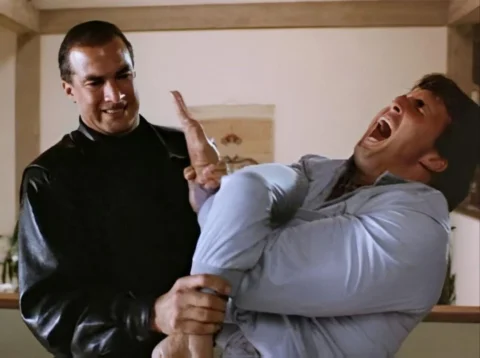
Born in 1994, I was too young to ever watch a new Steven Seagal movie in the cinema. By 2009 — when I could conceivably be old enough to watch one of his films — he was already a mainstay of late-night television; almost anytime you’d scroll beyond the regular channels, there he was, alongside Jean-Claude Van Damme, kicking ass and taking names, puffing himself up in the process.
As a result, he was always a kind of peripheral figure to me— never a true cinema star, more of a guilty-pleasure midnight man; especially as a large proportion of his films consisted exclusively of grabbing people’s arms and cracking them at life-altering 90-degree angles, something that always struck me as unduly harsh.
But Seagal has always been a bit extra, both in his insane ego (honestly, watch a movie of his and see how everyone lowkey praises him throughout) and in his ridiculous ability to appropriate every other culture with a complete lack of shame.
At once a Japanese aikido master, an honorary Russian and Serbian citizen, a man of Jewish and Irish descent, Italian-American passing, Native American-identifying (he claims Yakut and Buryatian descent; sometimes he says he is a Mongol), Black-sympathising and Oriental-obsessed, the pleasure of Seagal’s movies lies in the way there is almost no ethnicity or culture he can’t take for his own solipsistic ends. While some people may worry about stealing other people’s identities, Seagal seems worried he hasn’t stolen them enough.
He won’t just avoid your prom dress. He will wear it while looking so much worse than you.

In just his second movie, Hard to Kill (Bruce Malmuth, 1990) — caught yesterday on scratchy, nostalgia-inducing 35mm at Hackescher Höfe (and preceded by 35mm trailers!) — we already get a sense of Seagal’s bizarre fascination with East Asian culture, born out of his time in Japan (learning Aikido and avoiding the fag-ends of the Vietnam War). His character, Mason Storm, has been in a secret seven-year coma and needs to recover to take revenge on the people who killed his wife. So he asks the nurse looking after him, Andy (a terrible Kelly LeBrock, who was also his wife at the time), to head over to LA’s Chinatown to get the special herbs he needs. Naturally, he can write Chinese. She asks how he knows it. He replies, enigmatically:
When I was a kid, my dad was a missionary. I was raised in the Orient. As a young white boy over there, I needed to learn how to fight, as you can imagine. I remember my first martial arts teacher said to me: “So why do you come to me?” I say, “To learn how to fight.” And he says, “So you want to hurt people. But do you want to be great?” I say, “Yeah. I want to be great. He says, “Then first learn how to heal people to be great. To hurt people is easy.”
This entire monologue is not in the original screenplay, which suggests that the addition was Seagal’s own invention. It sure sounds like it, featuring his usual contortion of Orientalist bullshit and self-aggrandising bullshit. It is a theme that will pop up again and again throughout his work, which is always about how Seagal’s characters are somehow more in tune with other cultures than any other white man possible.

If it sounds like a criticism, well, it sort of is, but also, it sort of isn’t. I would say that Seagal’s movies aren’t entertaining despite his bullshit, but because of it, reaching a marvellous apotheosis in his self-directed On Deadly Ground (1994), which, in its identification with the indigenous peoples of Alaska, becomes the greatest tribute to self-aggrandisation ever made. Its highlight, of course, is the ending, which, like The Great Dictator (Charlie Chaplin, 1940), is one long monologue by Seagal himself about the need for environmental protection. Ironically, everything he says here, about the need for collective action and the need for curbs on big business, is absolutely correct, but it’s the manner of his presentation — and the montage! — which is simply ridiculous.
I haven’t watched On Deadly Ground in years, but certain scenes — kicking the racism out of somebody in a bar, his healing journey from Native Americans (a classic) — are indelibly sketched into my mind, the kind of cinema only a true deranged egotist could be capable of. What I did watch recently was his first DTV film, The Patriot (Dean Semler, 1998), a pandemic movie/Waco-siege riff which also features (spoilers) Seagal somehow doing in hours what took Moderna and AstraZeneca months: devising a vaccine from traditional herbal medicine. Where was he in 2020?
I was hungover when I wrote this on Letterboxd (Seagal movies are good for hangovers; you don’t have to engage the brain, really). I stand by most of it.

But while The Patriot and On Deadly Ground are pretty much earnest, Seagal’s subsequent forays into other cultures reach bizarre, uglier heights. Take Belly of the Beast (Tony Ching Siu-Tung, 2003), which is a kind of proto-Taken (Pierre Morel, 2008) set in Thailand. The action, directed by a Hong Kong veteran, is genuinely entertaining and well-done, but it features Seagal wearing all kinds of Asian garments, sleeping with prostitutes while refusing to take his clothes off, and possibly the most gender-affirming (yet misogynistic) line of his career, saying to a trans assassin whose shirt has ripped, “I liked you better as a bitch.” As the reviews say, it’s a deeply weird and emotionless experience: Asia as an exotic background, never lived in or meaningful. Still, the gun ballet rocks.
Yet even more problematic (and thus, in a perverse sense, more entertaining) is the fourth Seagal movie I watched this year: Today You Die (Don E. FauntLeRoy, 2005). Having somehow made money and relative success appropriating Italians, Japanese and Native Americans, Seagal decides he can more or less pretend to be a Black man.
This movie is wrong. This movie is also awesome. This is the way of the Seagal, especially as it opens with a theft gone wrong and Seagal being chased down the Las Vegas Strip; the action caught with surprising weight and verve by FauntLeRoy. (This is contrasted with the brilliant scene-chewing bad guy Kevin Tighe doing random riffs on Cool Hand Luke (Stuart Rosenberg, 1967) — and later Jerry Maguire [Cameron Crowe, 1996]) Eventually, Steve ends up in jail, where, to avoid being shanked, straight up puts on a Blaccent, teaming up with the wonderfully named Ice Kool (rapper Treach) in the simplest, most GTA-coded prison escape I’ve ever seen.1My wife, who was on her phone, turned to me after they escaped and said, “I thought they were in prison.” I had to inform her that they just got in a helicopter, and that was that. Job done.
But it’s not enough that Seagal takes on the mannerisms of a stereotypical Black man. In true Seagal solipsistic fashion, everyone has to tell him how Black he is. This literally happens when he walks into the back room of a Black bar:

And these movies mentioned above are just the ones I have seen. Over three decades, reflecting his ever-shifting claims about his heritage, he just loves appropriating other cultures. Over and over again. And it’s not just limited to movies. Check out his fucking terrible foray into reggae and dancehall!
Music aside, I think the reason it sort of works in the movies is that Seagal is being sincere. He is always painstakingly sincere. He is such a self-absorbed man; he thinks that, well, of course he can be Italian or Russian or Native American or Black or Japanese, because he is, of course, the most important man who ever lived, and is thus all men.
Is it appropriate? No. Is he a good person? Certainly not. Is it hilarious? Yes. Is it cinema? Definitely. Seagal, for all his faults, is one of the medium’s true originals. There will never be a man like him again.





Redmond is the editor-in-chief of Journey Into Cinema.
- Redmond Bacon

- Redmond Bacon

- Redmond Bacon

- Redmond Bacon