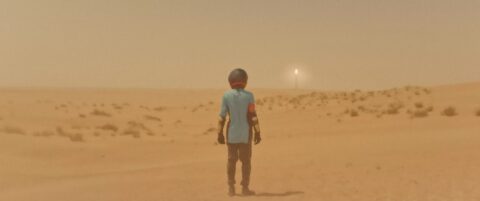
Skyscrapers melting into the sand. The landscape bending and shimmering, like an impressionist painting. Ochreous shades of yellow, brown and gold, battered by the sun’s unrelenting glare. This is the porous, unreal, ever-shifting world of Heat (Jacqueline Zünd, 2026) — not to be confused with the same-titled crime classic — an experimental documentary (playing in the International Documentary Competition) that goes to great lengths not only to show how rising temperatures are destroying vast swathes of the world, but also to represent this phenomenon through cinematic means.
Her subject is the Persian Gulf, where temperatures can regularly reach over 50 degrees Celsius (and can feel closer to 80 degrees in your car if you forget to turn the air conditioning on). Zünd films it like a bizarro space colony of the future, capturing the high-rises through the sand with Villeneuvian flair before taking us into a cyberpunk groove, affixing the camera to a delivery driver wearing a Daft Punk-helmet as he whizzes around the neon city at night.
This is a world where one cannot leave their apartments for large parts of the day, with expats running around a large building complex in lieu of celebrating fresh air, while advertising hoardings for villa complexes implore us to “Step Inside the Outdoors.” Meanwhile, an immigrant worker puts on a warm hat and gloves, for she’s working in an ice bar, catering for people with no idea of the true meaning of cold.
Paradoxes abound in this region, which seems to believe that, with enough oil money, the issues of the world will not apply to them. (For a region where mirages naturally happen, it seems they are obsessed with building them artificially, too.) The Iran war has been one such crude puncturing, but this may be nothing compared to the worsening climate crisis, threatening to turn the regime into a wasteland. As for now, the worst affected are the migrant class, including the delivery drivers, who brave their lives delivering food while others are left in their homes. To stress the way one, presumably from Africa, is viewed as merely an extension of a food application, our subject never takes his helmet off, shot zooming across the city like a side character in Akira (Katsuhiro Otomo, 1988).
Accompanying him is a concerned Kuwaiti weatherman, often seguing into methods for people to calm down while driving (avoid rock or techno music); a woman suffering from a breakup who gets really into helping cats; and an African woman working abroad to provide for her son. Together they form an oddball mosaic of a world far detached from Western reality (at least the one I understand), but yet somehow also the epitome of exploitative capitalism in its purest form — allowing the rich to live in their hermetic reality while the poor (especially migrant workers) suffer (and often die) from heat exhaustion.
A more dogmatic documentary might focus on slogans and calls to action, but Zünd’s curiosity takes her beyond the pressing headline of the title and into the strange humanity of her subjects. Take the post-break-up lady, for example (first introduced crying while smoking a skinny cigarette in her car). It’s not exactly clear how her story, neither calling to action nor suffering inordinately from the crisis, interacts with the main thesis of the film, yet her dogged care for these abandoned cats is strangely heartwarming. It provides a much-needed grace note in an otherwise despairing vision.
Redmond is the editor-in-chief of Journey Into Cinema.
- Redmond Bacon

- Redmond Bacon

- Redmond Bacon

- Redmond Bacon