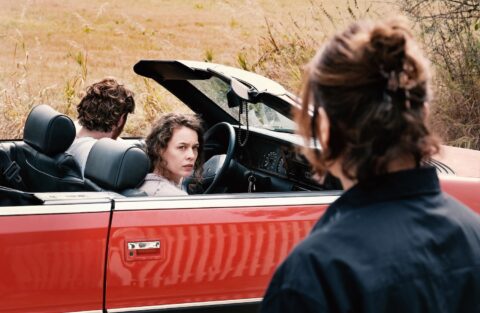
Veteran German filmmaker Christian Petzold’s latest film, Miroirs No. 3 (2025), is a sparse tale functioning like an experiment in passive observation. Its story is set on the outskirts of the city, where Laura (Paula Beer), a piano student, survives a car crash that kills her boyfriend. When Laura awakes, she finds she has been taken in by Betty (Barbara Auer), an older woman. As Laura recuperates, she forms a mother-daughter bond with Betty, but something unspoken troubles the older woman, as well as her husband Richard (Matthias Brandt) and son Jakob (Philip Froissant).
Petzold’s credits include the “Love in Times of Oppressive Systems” trilogy, (Barbara [2012], Phoenix [2014], and Transit [2018]), the “Ghosts” trilogy (The State I Am In [2000], Ghosts [2005], and Yella [2007]), and the “Elements” trilogy (Undine [2020], Afire [2023], and Miroirs No. 3).
Speaking with Journey into Cinema ahead of the UK release, Petzold discussed the Hitchcock and Lewis Carroll connections, awakening the senses, disagreeing with his children and the film’s hidden politics.
The following has been edited for clarity.
With an ever-expanding filmography, what has continued to drive you as a filmmaker?
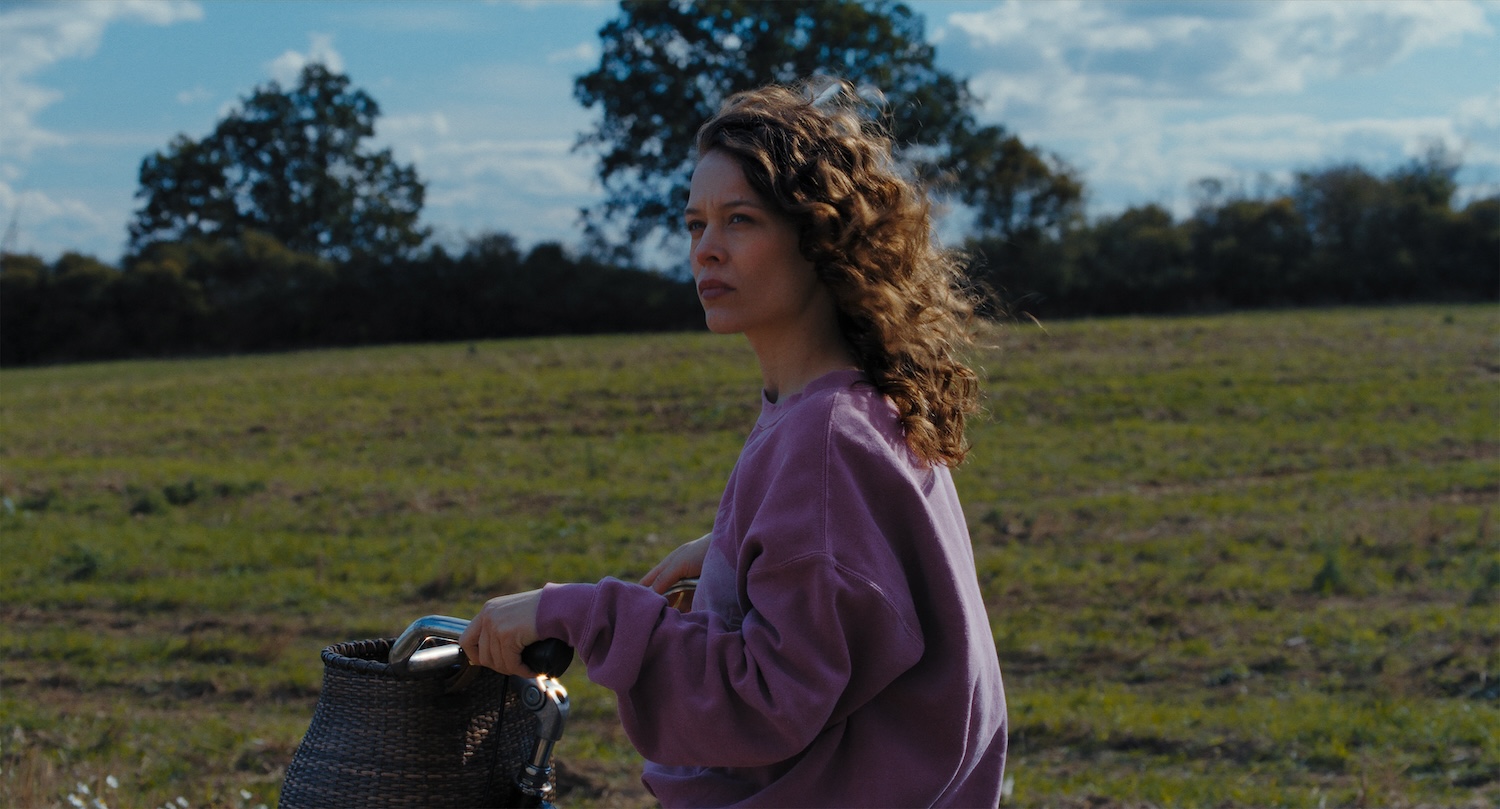
This morning during breakfast, my wife asked me what I’d say if I was asked what the main subject of my movies was? And I said, “I think it’s the poetry of fortune seekers.” I’m always portraying people who are trying to survive or seek fortune because the cinema is all about work.
You never see factories or so in cinema. Sometimes you’ll see it in a Paul Schrader movie like Blue Collar (1978), but because the first movie ever made was Employees Leaving the Lumière Factory (1895) by the Brothers Lumière, cinema starts when the factory work is over, which means it has something more to do with entertainment and so on. But cinema itself shows how love and desire work, not factories. And so, it’s about people who are on the run, who are trying to survive, and who are trying to find their identity.
This is what I told my wife, but she was totally bored after five minutes of me talking. She makes documentaries, and so she has more patience. Or she has patience for the work, but not patience in our relationship.
What was the genesis of the idea for Miroirs No. 3, or more specifically, what were your intentions for the story?
I have two adult children that are radically left-wing. After they saw Miroirs, they said it wasn’t political, and I needed to make another political film. I told them that Miroirs is a political movie, but not in its subject. Instead, it’s more of a political movie because it’s about people who are trying to repair things. This was the movie’s metaphor.
The characters try to repair cars and dishwashers, houses and fences, but they also try to repair their minds, their relationships, their loves, and their desires. However, the capitalistic world doesn’t need people who repair things because things need to be sold. When something’s broken, you throw it away and buy new. To repair is a communist idea.
Our world is now under pressure from the fascists who hate to repair things. The fascists want to clean up the world as in the tabula rasa (blank slate). So, when you see the fashionable architecture in Germany between 1933 and 1945, nothing was repaired. Instead, they just did away with the old to build something new.
After a 20-minute monologue, my children agreed that the film is political. And this metaphor of repairing is one of the most important aspects of Miroirs No. 3.

Miroirs No. 3 is a film where it might seem like nothing is happening, because it hides its themes and ideas behind a narrative and aesthetic simplicity.
Yes, that’s right, and my decision not to use a musical score was because you know nothing about the young woman played by Paula Beer.
I had shot a scene where she’s sitting at the piano in the university, where she has a panic attack. But I cut it out of the movie, and Paula asked me why. I told her we didn’t need it because the whole movie is a little bit like a tale. If you remember, in Alice in Wonderland (Lewis Carroll, 1865), we know nothing about Alice. Everything begins when she’s falling down the hole, and cinema has to work like this. And with this film, I thought it should be like we are falling down a rabbit hole.
So, she’s standing on the bridge, and there’s water, which is a classical scenario. It has something to do with sentimentality and suicidal tendencies. And it has something to do with these old paintings — young women and water. You can find these paintings in every museum in the world. Then, she’s going down to this canal where there’s this guy with a stand-up paddleboard. He’s like the ferryman on the river Styx who takes you to the world of the dead.
It’s like a dream, it’s like a tale, and everything is very simple. And at that moment, I made the decision that it’s about a piano player. I decided I didn’t need a score because she, and we as the audience, need to learn to see and hear the world again. During Covid, we had to stay indoors, and so, young people especially need to learn to open up their senses again. This movie is about that process.
What are your lasting impressions of Miroirs No. 3?
My impression after the premiere at Cannes was this feeling that the movie is more a memory of a movie. When I was fourteen or fifteen, there were older guys I knew who could go to movies I was forbidden from seeing because they were X-rated — films like The Evil Dead (Sam Raimi, 1981). I asked them to tell me what the story was about or what they had seen. Some of them were really good storytellers, and I could see it in my head. This was a little bit like my impression of Miroirs.
In Hitchcock’s Foreign Correspondent (1940), there’s a scene where one of the windmills is not working, and inside he finds a diplomat being held hostage. In Miroirs, in this part of Germany where this family lives, many of the homes are weekend houses, whose terraces or porches are at the back. These families don’t want to have contact with the world, and when I went through this part of Germany, I saw one house whose porch was on the front, as if there were people living in that house that wanted to be sociable and connect with people. So, this house is a little bit like the windmill in the Hitchcock film.








Casper Borges is a film writer whose writing has also been published by Eye For Film.