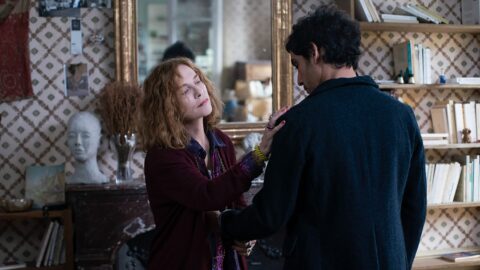
Since its premiere last week, Parallel Tales (Asghar Farhadi, 2026) has received scathing reviews, sitting near the bottom on Screen’s jury grid. But the plots aren’t really the point of this film. It’s, after all, a tribute to Krzysztof Kieślowski, every shot a reference, every object a memory. If there ever was an all-nighter marathon of Kieślowski’s most celebrated films, Parallel Tales would be the induced fever dream.
Unexpectedly hearing Dekalog (1989) scores is already enough to bring tears to a fan’s eyes. Spying on the woman in the building opposite. Her hair the same style as in Dekalog: Six / A Short Film About Love (1988). Father catches mother cheating with the perfumed neighbour. Finds out in the same way as in Three Colours: Red (1994). Cousin with the hairstyle of Irène Jacob. Mice babies from Three Colours: Blue (1993). Someone suddenly dies around thirty minutes, as if in The Double life of Véronique (1991).
As the car drives into the distance, the subconscious already registers the impending doom. Triggers the memory of Dekalog: Five / A Short Film About Killing (1988). This time it’s cable wires instead of ropes. It simulates the experience of premonition, that we constantly feel as if we know what’s going to happen, echoing the theme of Véronique and Dekalog: One. Then memory kicks in, and we realise we have already seen the film.
In fact, almost every little detail comes from Kieślowski. The recurring motif of milk from No End (1985) and a few Dekalogs, the church reflected in Weronika’s crystal balls in Véronique, the old lady with a hunched back from the Three Colours, the theme of intuition and interconnectedness of human lives. It’s quite like a classic adaptation, a literary reinterpretation, desperately trying to fit every character from the Kieślowski universe into one story. Every frame evokes a memory; of Véronique listening to the tape, of the parallel lives of two women.
But the focus here lands on the impossibility of knowing other people. Like the main character in this film, we all make assumptions about other people’s lives based on the literature we consume, on our imagination of the world. After all, how can we really know someone else’s life? Their thoughts, love, longing and their imagination about us. The world is only our perception of the world, and in this case, simply a Kieślowski fanfiction. When the credits rolled, the names of Véronique and Julie caught the eye. Perhaps we all just see what we want to see.
Ariadne is a film writer specialising in sensory and arthouse cinema.
- Ariadne Si Suo

- Ariadne Si Suo

- Ariadne Si Suo

- Ariadne Si Suo