A perfect antidote to all the coming-of-age snoozers littering the festival scene, Giovanni Tortorici’s Ketticè (2026), produced by Luca Guadagnino, hits all the right notes of a teen comedy. It’s rude, crude, slightly obnoxious and, for most of its running time, completely uninterested in behaving itself. Set in Palermo in 2012, with Berlusconi still looming over Italian public life, the film follows 16-year-old Giulio (Salvatore Gallina), a directionless kid who has little interest in school and even less interest in figuring out what he is supposed to do with his life. He smokes a lot of weed, skips class, hangs around the piazza with his crew and generally treats any attempt by an adult to get him moving as an invitation to dig his heels in further.
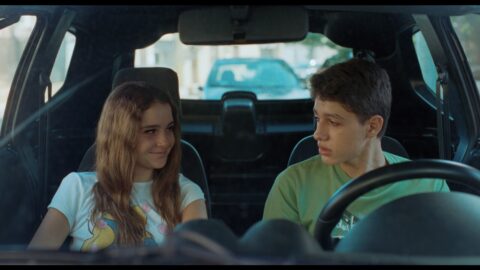
After his girlfriend dumps him via text, he meets Ketty (Rachele Tesagrossa), and the two quickly fall into an intense little world of their own. Mostly just smoking weed and chatting shit in a parked car. There’s a loose, stoner-comedy quality to their relationship, but Tortorici never turns Giulio into some secretly brilliant teenager waiting to be understood. He’s stubborn, irritating and frequently his own worst enemy — the film is happy to let him be all three. What makes Ketticè work, though, is that Tortorici slowly reveals there’s more at stake beneath all the juvenile delinquency and aimless wandering. So, when the film finally gets serious, it doesn’t feel like a bait-and-switch.
Ketticè feels like the flipside to Tortorici’s last film, Diciannove (2024), about a hyper-intellectual teenager who ditches his plans to study business in London and instead returns to Italy to bury himself in literature. Like Diciannove’s Leonardo, Giulio is uncertain what he’s doing with his life. He’s a few years younger, but both films capture that period when every decision feels life-defining one minute and completely arbitrary the next. They’re less interested in where these young men are headed than in the confusion of trying to figure out who they are while the world around them keeps insisting they should already know.
One of the film’s funniest moments comes when Giulio’s grandmother comes to visit. She arrives serving a look the way only wealthy Italian women can, and is somehow sassier than all the girls Giulio goes to school with put together. She mentions she’s rereading The Leopard (1958), Giuseppe Tomasi di Lampedusa’s classic novel that Luchino Visconti later adapted for the screen (1963), while Giulio barely bites. The scene reveals a gap between generations: one that grew up believing books and art were essential, and another more interested in smoking joints, getting into fights at the park and stalking each other on Facebook.
It could easily have been a scene about how kids these days don’t read anymore, but Tortorici never makes it that simple. Giulio isn’t a dumb kid; he just couldn’t care less about The Leopard, and his grandmother isn’t exactly interested in meeting him halfway either. They’re basically speaking different languages. That dynamic keeps popping up throughout the film. His mom (Monica Belucci) is constantly on his case, his teacher is losing patience with him and his classmates, and Giulio seems genuinely baffled by why everyone is so obsessed with getting him to care about school and his future. Nobody really comes out looking right or wrong. They’re just different generations irritating the hell out of each other.
That same teenage aimlessness and intergenerational conflict makes Ketticè feel like a spiritual 2012 sibling to Dazed and Confused (Richard Linklater, 1993), and not just because both films feature plenty of joints. Giulio has something in common with Randall “Pink” Floyd, Jason London’s character: he’s capable and talented, but increasingly detached from the expectations placed on him. Pink is a gifted athlete who feels more at home cruising around with his friends and smoking a joint than listening to his coaches; Giulio has that same instinct to opt out rather than figure out what he is supposed to be opting into. Anyone who started smoking weed as a teenager will recognise that feeling — the way getting high, listening to music, and doing fuck all with your friends can feel like a temporary escape from the pressure to already have your life figured out. Sometimes just hanging out with people can be a way to learn more about yourself.
The soundtrack is almost aggressively bad. Trashy pop, corny EDM and thumping reggaeton are constantly dropping into the film, sometimes coming from the characters’ world and sometimes simply playing over a scene. It’s another thing that makes Ketticè feel firmly rooted in 2012, and Tortorici never tries to disguise the kids’ questionable taste as something cooler than it is. Some of the music is genuinely awful (lol Flo Rida), but after a while that becomes part of the fun.
That loose, lived-in feeling carries over into the film’s visual style, too. Ketticè is bright and colourful, with lively editing by Marco Costa that keeps its wandering energy from ever feeling sluggish. Tortorici and cinematographer Camilla Cattabriga also pepper it with little visual jokes — an unexpected zoom here, a sudden close-up there, the occasional burst of slow motion — but use them sparingly enough that they feel like punctuation rather than a gimmick. For all the control behind the camera, the film never loses that sense that anything could happen next.
There isn’t a huge amount of conflict or conventional drama in Ketticè. The central question is quite simple: is Giulio going to keep floating through life like this, or will he eventually figure out what he actually wants? Another thing that makes the film work is that it never tries to sanitise its teenagers’ bad behaviour or force their lives into a tidy moral lesson. The boys can be casually misogynistic and completely obsessed with girls, while the girls are just as salty, quick to clap back, and ready to go from arguing to throwing hands at a moment’s notice. There’s obviously a lot of learned behaviour behind the way they act, but the film doesn’t pause to explain it or turn every interaction into a teachable moment.
That honesty comes from how specific the world feels: where the way these kids talk, joke, flirt and clash with each other feels inseparable from their Sicilian roots. From beginning to end, Ketticè is a constant delight, and certainly one of the funniest screenplays in recent memory.
Editor-at-large Jared loves movies and lives with Kiki in Berlin.
- Jared Abbott

- Jared Abbott

- Jared Abbott

- Jared Abbott