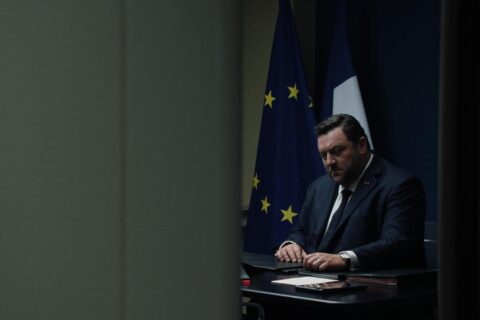
In today’s Ozempic era, where many actors are losing the very physicality that made them so appealing in the first place, it’s a great pleasure to see that Denis Ménochet is still a veritable tank of a man. As the president of France — Jupiter himself, as Emmanuel Macron has famously styled himself — he absolutely dominates the frame, lending this nuclear drama the gravitas it needs.
Essentially a French take on A House of Dynamite (Kathryn Bigelow, 2025), Jupiter (Alexandre Smia, 2026) is awash in classic Republicana — the tricolour flag, the grand Élysée Palace, references to the constitution, De Gaulle and Presidential authority — making for a delightful fantasy where, in the case of nuclear annihilation, the entire balance of power hangs in French hands located in a secret bunker.
Their justification rests on the fact that France is the only nuclear nation on the UN Security Council, part of the EU, and part of NATO. And consider the alternatives? Germany does not have nuclear weapons; the UK no longer has relevance; the USA is being run by a female Trump (Juliet Aubrey) with zero qualms about snaking the Ukrainian president, Kovalenko (Mark Ivanir). Only France can quell Russia’s nuclear blackmail threats.
In a call between presidents Archambault and Chernov (Valeriu Andriutu), where Archambault tries to get the nearly-assassinated Russian leader to dial down his threats of wiping Ukraine off the map, it’s hard not to think back to the very real phone calls Macron and Putin had the day before the full-scale invasion. On the one hand, you have a sober and rational Frenchman; on the other, a disembodied voice, unlike the other world leaders seen over video link, betraying either a madman or a man pretending to be one to get Ukraine to capitulate completely to Russia. The links are very obvious, and exceptionally sad.
Because, for all his domestic faults and inability to wipe the far-right out of his own country (a far more dangerous threat to France, perhaps, than Russia), there is something rather likeable about Macron, who seems normal and level-headed in a way that no British or German leader has been in a very long time. While probably twice his size, Ménochet embodies a similarly rational approach to the crisis unfolding before him, weighing his words carefully, thinking clearly, moving slowly; accentuated by very long takes and a great deal of close-ups that reach Leonesque proportions.
Yet, as the uselessness of Macron’s phone call proved to be, Jupiter is less interested in a Sorkinesque chatty ideal of saving the world through talking than the very real paradoxes of trying to stop the worst from happening.
After all, the thing with nuclear warfare is that there are no good solutions to de-escalate if someone is truly willing to go all the way. And anything you do could make it worse. As Slavoj Žižek mentions in his newsletter, mentioning nuclear warfare as one of the three great crises, along with the climate crisis and the rise of AI: “we cannot exclude the possibility that what one side of the conflict perceives as its own still-limited aggressive act, the other side will take as crossing the red line and respond to with nuclear strikes.” Jupiter examines these difficulties with great care and sobriety, making for a chilling, dark experience, as well as yet another showcase of Ménochet’s singular cinematic presence. He’s one of our great actors. Let’s get him in more movies.
Redmond is the editor-in-chief of Journey Into Cinema.
- Redmond Bacon

- Redmond Bacon

- Redmond Bacon

- Redmond Bacon