Is there any better metaphor for wealth inequality than skyscrapers?
I was in Kuala Lumpur a couple of months ago, and upon the insistence of my view-obsessed friend, went up to the 98th floor of the Merdeka 118, the second-tallest building in the world. Right on that gravity-defining level, while the building literally shakes, is an executive office room, perfect for businessmen who want views of the entire city while conducting high-pressure deals.
Even further up, although not open yet (we were faced with a brick wall when we got to this floor), on the 118th floor, are the soon-to-open sky rooms, offering breathtaking scenery, only available for the absolute higher echelons of international and Malaysian society. At this point, it’s worth pointing out that this absolute monstrosity, often blocking out the sky like something portentious out of a fantasy novel1We stayed at Four Points, with the building literally following me around., was entirely state-funded. Was this $1.25 billion expenditure really the best use of public funds?
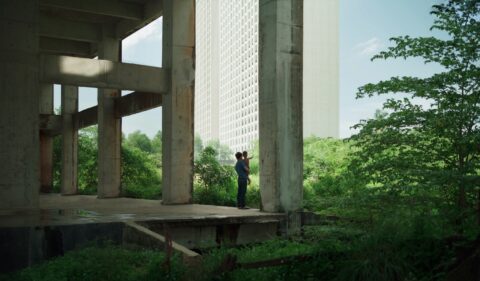
I couldn’t stop thinking of Merdeka 118 while watching the Cambodian-shot Promised Lands (Ivan Marković, 2026), which clearly delineates the divide between rich and poor before cleverly blurring the lines through a subtle interrogation of a construction site’s liminal spaces. With a mixture of documentary footage and slow character drama, closer to the work of Tsai Ming-liang than anything from Marković’s native Serbia, Promised Lands is a careful observation work that immerses us into this nascent, unreal, ever-developing world.
The first part concerns Sokun (Vollak Kong), who wakes up a homeless worker (Chea Loch) sleeping at the base of one of these mega high-rises. He takes him to an encampment filled with transient workers, reflecting on the changes to the neighbourhood, which has transformed from a sleepy village to yet another Southeast Asian megatropolis. Later, the homeless man makes it onto the building’s outdoor pool, the lights of the city shimmering enigmatically in the water, stealing, for a brief moment, the feeling of being a truly moneyed Cambodian.
Their story is later contrasted with Seda (Vita Vong), a rich woman who ends up being the first tenant to move into Oasis Park (Subtitle: “Elevate Your Life”). Yet instead of her life being rich and plentiful, she suffers from a certain ennui, punctuated by the substandard living conditions of her flat, and the seeming unknowability of the working-class citizens who occupy her building. The result is an intellectually rigorous experience, using duration to take us into her headspace and stress the porousness of the class divide.
Marković has worked extensively as the DOP behind the films of the formidable Berliner Schule director Angela Schanelec, who often foregoes conventional narrative in favour of exacting, demanding films, filled with gorgeous frames, but absolutely unfollowable storylines2I skipped her last film at Berlinale, sorry. Was drying my hair.. And while his own film, co-shot with Katharina Hauke, is more conventional in terms of plot, it follows a similar preference for atmosphere over closure; complemented by careful sound design (the whirr of crickets, the falling of rain, the silent humming city in the background) and many pillow shots finding pockets of rurality in an otherwise urban scene. The effect is immersive and fascinating, yet, regrettably, not without moments of prolonged tedium.
Redmond is the editor-in-chief of Journey Into Cinema.
- Redmond Bacon

- Redmond Bacon

- Redmond Bacon

- Redmond Bacon