As a lifelong dog lover and current dog-dad to a 17-year-old named Kiki Louise, you’ll rarely find me hating on a movie about canines. I like it all — from sappy Hollywood dramas like Marley & Me, (David Frankel, 2008) to deranged 90s kid movies like Bingo (Matthew Robbins, 1991), to even the more ludicrous ones from that same decade like Man’s Best Friend (John Lafia, 1993), with Ally Sheedy rescuing a killer Tibetan Mastiff that’s been genetically engineered by an evil scientist (Lance Henriksen) and starts wreaking havoc all over the neighborhood.
I can even fuck with those annoying copaganda films with Jim Belushi, Tom Hanks or Chuck Norris dorking out and solving crime with a dog as their partner, or 70s Spanish satires that use dogs as a metaphor for fascism like La criatura (Eloy de la Iglesia, 1977). And I just watched and enjoyed that howlingly awful “film” Liza (Marco Ferreri, 1972) with Catherine Deneuve playing a rich weirdo who kills a lonely man’s dog just so she can engage him in some pervy pup-play.
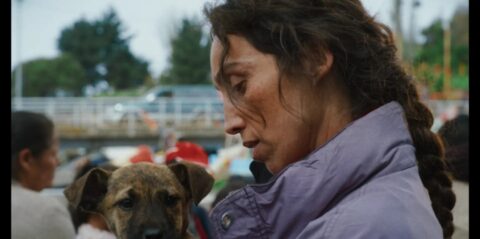
Sadly, I found little enjoyment in La Perra (2026), the latest from Chilean director Dominga Sotomayor. It follows a quiet woman living a quiet life on a desolate island who adopts a puppy, an act that stirs up a childhood memory and forces her to reckon with unresolved trauma. It’s a messy, uneven film that’s still gorgeously shot — but it’s got one of the worst endings I’ve seen in a while.
Silvia lives on the remote Santa Maria Island, where life revolves around fishing and collecting seaweed for export, surrounded by rugged coastline. She leads a simple existence with her man, some cash from the seaweed hustle and her own garden. One day, fishermen find a dog abandoned at sea, and Silvia adopts one of the puppies, naming her Yuri.
The first act starts off promising, but it sets up a story that becomes more and more emotionally convoluted. Those opening 30 minutes give a vivid sense of what life in such a desolate place actually feels like, not just for Silvia, but also Yuri, who adapts to island life quickly. She enjoys being a good girl, barking at horses and chewing on crab shells. Meanwhile, Silvia’s main connection to the outside world is nighttime TV singing competitions. She loves the big emotional ballads like Myriam Hernández’s 1998 hit “Huele a Peligro” (which she sings at karaoke) and Yuri’s 1985 Mexican banger “Yo te Pido Amor” (she probably named the dog after her). The film hints that Silvia has a deep emotional wound tied to motherhood, and caring for the puppy briefly seems to bring her to life…
…but then Yuri runs away, and we’re suddenly yanked back into the past. We still don’t fully understand what’s haunting Silvia, only that the wound runs deep. From there, the film slips into a kind of agonising dread: you spend the entire second act following an innocent child through this gorgeous landscape, waiting for the hammer to drop. A Brazilian architect arrives on the island with his family and — without spoiling anything — the situation turns ugly fast. Sotomayor hints at something even darker than what ultimately happens, though what does occur would still scar anyone for life. The sequence is tense and skillfully staged, but it never crashes into the present-day storyline with Yuri as forcefully as it should.
I’ve never read the Colombian novel this is based on, but it feels like the kind of interior, psychologically tangled material that’s difficult to adapt. Themes of motherhood, abandonment, trauma and animal instinct never fully cohere onscreen, despite Sotomayor’s striking imagery. The result is a beautiful but frustrating film that ultimately lands on an ugly, cynical final note.
Editor-at-large Jared loves movies and lives with Kiki in Berlin.
- Jared Abbott

- Jared Abbott

- Jared Abbott

- Jared Abbott