It’s like this: to rise above the endless flow of interchangeable, ersatz social-realist dramas clogging the festival circuit, a film has to offer something genuinely memorable or deeply felt. There has to be more than shaky handheld cameras and recycled woke-ish commentary on the social ills of the moment.
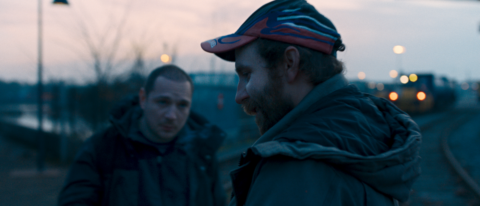
Pierre Le Gall’s Flesh and Fuel (2026) does exactly that. Working from a familiar template — a star-crossed love story between two wounded souls in thankless jobs — the film follows two truckers who meet at a sketchy nighttime cruising spot and turns the premise into something unexpectedly affecting. I watched it twice (partly to make sure I wasn’t just in a lonely homo mood), and it hit just as hard the second time.
Étienne (Alexis Manenti) is a French long-haul trucker who once drove all over Europe but now mostly grinds the same route between France and England. His brutal schedule leaves no room for real personal life (he rarely sees his sister and nephew), so he settles for anonymous hookups in truck-stop car parks and cruising areas. One night, he meets Bartosz (Julien Swiezewski). After the two narrowly escape a police raid, they instantly click (fuck some more) and trade numbers.
Set in loading docks, warehouses, truck stops and dark highways, Flesh and Fuel immerses us in the other Europe — the one you never see on postcards. These are places where the endless grind of moving goods never stops, sustained by people who sacrifice normal lives. The film’s strongest images come straight from this world: smokestacks exhaling into the night, rows of trucks eerily lit at petrol stations. Then, briefly, it opens up. A daytime bridge sequence actually feels like a postcard, cutting against the dreariness.
The two men cross from opposite directions, talking on their phones and perfectly timing it so their rigs pass just long enough to honk and wave — an exhilarating, hopeful, deeply romantic interlude.
Real life quickly comes crashing back in. Their schedules are simply too chaotic for anything lasting. Hooking up and texting now and then is easy, but anything more feels nearly impossible. You can also feel the grind of European capitalism in the background — Bartosz is pushed to drive much longer hours for a Polish company and gets paid noticeably less than Étienne. That imbalance creates a natural tension between them that never feels shoehorned in.
Le Gall avoids the usual condescension toward working-class men in hyper-masculine environments. It hints that homophobia may contribute to Étienne’s guardedness, yet plays with expectations. In an early scene at a retirement party, a younger driver gives the guest of honour a joking lap dance to “Down in Mexico,” (The Coasters, 1955)1Hello, Vanessa Ferilito in Death Proof (Quentin Tarantino, 2007) leaving Étienne visibly uncomfortable. It’s clear he’s not out at work. Later, once he learns Étienne is gay, the same guy casually says, “whatever makes you happy.” For someone not open with their co-workers, those four words mean a lot.
I genuinely love how unfetishized it all feels. The “rough trade” element is there, but the gaze is never indulgent or leering. These are simply men who fuck other men — and when they do, it’s both erotic and ridiculous in the way real sex often is, especially in the tight confines of a truck cab.
One of the best sequences is their first hookup: all elbows, knees and breathless fumbling. The camerawork and performances capture the cramped intimacy without smoothing anything out, holding both the awkwardness and the heat. The film understands that desire in such close quarters doesn’t allow for elegance — and finds humour in it, like getting railed so hard you accidentally hit the horn and wake up half the parking lot.
The casting is superb, as if the roles were written to showcase both actors’ strengths. Alexis Manenti is excellent in his wheelhouse — shy/brooding, stoic, and intense, with a teddy-bear tenderness underneath. But Julien Swiezewski steals the show. He’s got a magnetic, live-wire energy: charming yet visibly on edge, a man wounded by a rough past who feels not dangerous but dangerously alive (and really fucking exhausted).
Like many road movies, Flesh and Fuel plays on the irony of the open road becoming a form of confinement. What looks like freedom locks these men into lives with no space for anything lasting. On paper, the stakes might seem small — two guys who can’t quite get it together and compromise… so what? Yet the way they come alive around each other reveals something anyone can relate to: the pain of possibly losing someone who could be the love of your life. Will all this masculine stubbornness, bad timing, demanding job stuff, and distance pull them apart forever? It’s an old story, but here it hits in an unshowy, genuinely gutting way. The film argues that work matters — but you can’t let it swallow you so completely that you let real love slip away.
Editor-at-large Jared loves movies and lives with Kiki in Berlin.
- Jared Abbott

- Jared Abbott

- Jared Abbott

- Jared Abbott