For the better part of six decades, Steven Spielberg has evinced a lifelong fascination with an ever-relevant core tension: mysterious encounters with the unknown and their relationship to conflicts within our own families. Just as we cannot truly know the wonders of the universe, nor wield the right responsibility upon uncovering such marvels (see the end of Raiders of the Lost Ark [1981], or the dinosaurs running amok in Jurassic Park [1993]), we will never be able to come to terms with the ways our parents have treated us — and by extension, the way humans, at their worst, can treat one another.
Who can forget Close Encounters of the Third Kind (1977), which is as much about the magical idea that we are not alone as it is a reverie on absent fatherhood? In his unique combination, often skirting the limits of sentimentality without devolving into sappiness, Spielberg’s vision is one of personal neuroses, issues and trauma coming into contact with the sublime, allowing us to refocus on what truly makes us human, despite, or perhaps because of, our true smallness in the wider universe.
Returning firmly to science-fiction territory, Spielberg’s latest film, Disclosure Day (2026), is a grab box of the famed director’s greatest hits. In many ways, it is a sincere reflection on the ineffable links between childhood trauma and a desire for greater revelation. Yet, while he cannot be accused of half-hearting his latest instalment, it unfortunately suffers from an inability to clearly create those connections that characterise his best family-focussed science-fiction, such as the aforementioned Third Kind, E.T. the Extra-Terrestrial (1982) and A.I. Artificial Intelligence (2001).
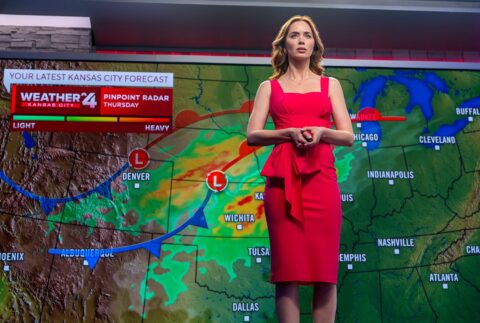
It starts promisingly enough, however, with a scene of great mystery and tension, the plucky Dr Daniel Kellner (Josh O’Connor), accosted by agents at a wrestling match, before coming face-to-face with their boss Noah Scanlon (Colin Firth) in a loading bay, all rising steam and dark shadows. His subsequent getaway, alongside his girlfriend Jane (Eve Hewson), is contrasted with the more enigmatic, puzzling story of weather news anchor Margaret Fairchild (Emily Blunt), who dreams of bigger things than her current role predicting hail at the local Kansas City news station. To say much more than there’s a big conspiracy and uncovering it will change humanity forever is to give away the chief appeal of the movie, which is going in blind and seeing just what all the secrecy is about.
Considering that Spielberg is basically Mr Cinema, with more masterpieces to his name than some entire countries, I was very excited for Disclosure Day. Sadly, having been imitated by countless directors, most notably Star Wars-destroyer J.J. Abrams, Spielberg has squared the circle, and not only plagiarised himself (which one, of course, would call style), but gone full steam ahead and made his own Abrams film. With endless mystery box storytelling courtesy of David Koepp’s by-the-numbers screenplay, including a stupid magical object that is never fully explained, endless lens flares and unnecessary boilerplate reaction dialogue (“What the hell just happened?”), Disclosure Day often comes across as a tribute to Spielberg’s oeuvre à la Abrams rather than a genuinely fresh vision. Rather than subverting expectation and the perils of nostalgia, which Ready Player One (2018), for all its faults, managed quite savagely, the auteur gives in to the perils of an easy reunion lap, offering us little more than a shadow of his better work.
Nonetheless, for those who relish Spielberg less for the plot than his signature shots, there are a few pleasures to be had here. For example, in an early, virtuosic multi-beat take, Spielberg’s long-standing DOP Janusz Kaminski takes us from Daniel’s stolen gear to outside the car before revealing more agents through a car window, emerging from a stairwell. And later on, when Scanlon is discussing which former employee has betrayed him, the glass door shuts, revealing the culprit’s face in the reflection. This is the kind of layered, pleasing cinematography sorely missing in contemporary cinema, guiding us through the story with a high level of aesthetic control.
Yet somehow Spielberg falters when it comes to what used to be his real bread-and-butter: proper action sequences. Unlike the spellbinding chase scenes of his two early 00s masterpieces, Minority Report (2002) and War of the Worlds (2005), Disclosure Day’s popcorn moments are extremely lacklustre, suffering from no real tension and glaring logistical/spatial awareness issues. We get the sense that the film is rushing through these parts to get to its more teachable moments, which boils down to: if only we could understand each other better, if only we could empathise, if only we could understand that we all have family shit to deal with, then perhaps the world would be a better place. Sure, I agree, but does that make for engaging, enjoyable, memorable cinema, or couldn’t you just fit that message on a placard? Here, the medium doesn’t fit the message, and Spielberg’s schtick just feels plain tired. A galactic disappointment.







Redmond is the editor-in-chief of Journey Into Cinema.
- Redmond Bacon

- Redmond Bacon

- Redmond Bacon

- Redmond Bacon