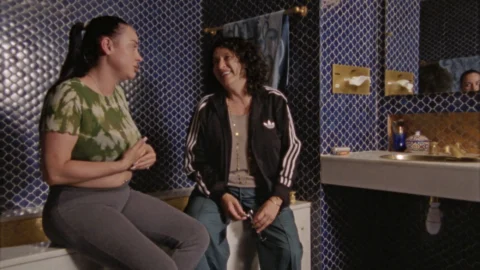
Argumentative, opinionated and Jewish, living in the spaces between genteel Paris and its more seedy underbelly, Shana (Eva Huault) feels like a long-lost cousin of Vincent Cassel’s Vinz, immortalised in La Haine (Mathieu Kassovitz, 1995). And like Vinz, her more spontaneous and ill-judged decisions, as well as an ambivalent relationship to the practices of her religion, end up getting her into all kinds of trouble.
In an apposite early scene, Shana (2026) director Lila Pinell contrasts the dipping of wine at Seder — captured on film in oozing blood red — with Shana applying her nails. With full liposucted puckers, a loose-fitting bra and long hair extensions, her highly feminine appearance brings much dismay to her mother, Yolande (Noémie Lvovsky), who doesn’t think that this is an appropriate look for such a reverent occasion. To the family, perhaps, but in terms of cinematic portrayals, there seems to be nothing more Jewish than some schlemiel raining embarrassment upon everyone else.
Operating like a Safdie film but in a more low-key, Euro-arthouse and feminine mode, Shana is an entertaining examination of a confused, emotionally vulnerable young woman who simply can’t help but give in to all of her worst impulses. Held together by a compelling performance by Huault, allowing us somehow laugh with, at and against our plucky yet impulsive protagonist all at the same time, this is a confident work rich in sultry textures, sly humour and a playful sense of tone.
Our hero has little direction in her life, even hiding the fact that she has a boyfriend from her Moroccan grandmother (Geneviève Krief). She has good reason to: Moises (Sékouba Doucouré) — whose very name brims with all kinds of religious implication — is a) a drug dealer, and b) in jail. Yet he still manages to constantly call her, giving her directions about how to keep up their illicit operation.
With naturalist performances yet with a Gen Z-style film filter — all soft tones and blue-purplish hues — that evokes the first two seasons of Euphoria (Sam Levinson, 2019-2026), Shana manages to balance lived-in Paris life and the rhythms of everyday speech with something more heightened and theatrical. This blend tends to keep the urgency of the action at bay, which makes it all the more powerful when strong emotions do push through, such as when Shana confronts her biological mother about being placed in foster care at the age of 12. At this point, her life stops becoming a joke, but rather a wounded product of neglect and poor circumstances that no return to ritual and tradition can so easily mend.
Yet these moments are pretty few and far between. More picararesque than thrilling, I’d say Shana is more happy to play with its protagonist’s identity and overall fierce aura than probe it too deeply through drama, especially in the shrug-of-shoulders attitude of the final denouement. It’s all carried by Hault’s lackadaisical, yet subtle gestures, as if she is creating a person in real time. A quietly profound performance.
Redmond is the editor-in-chief of Journey Into Cinema.
- Redmond Bacon

- Redmond Bacon

- Redmond Bacon

- Redmond Bacon