The return of Captain Thunderbolt (Cecil Holmes, 1952) to the big screens is a beauty for cinephiles. Having played at the festival 74 years ago, the complete version was considered to be lost, with only a 55-minute TV version existing in the Australian National Film and Sound Archive. But the film was rediscovered in Prague two years ago, and returns to the festival for the 60/80 edition, celebrating the 60th edition of the festival since 1946.1Karlovy Vary is actually the second-oldest film festival in the world (after Venice, 1932). The reason there have only been 60 editions is that they were forced by the Soviets to alternate with the Moscow film festival between 1959 and 1993. The USSR was self-aggrandising like that. Basically put, this lightly anti-colonial film only exists because of this festival, thousands of miles away from its New South Wales setting.
What a pleasure this film is to rediscover, which, while perhaps not a classic by American Western standards, stands as a true barnstorming Australian entertainment, a lovely Bushranger picture, and a sly work of comic ingenuity. Decades before their cinema had its international moment, this early all-Ossie picture, made just after a thirty-year ban was lifted on films about outlaws, brims with eye-catching scenes, innovative camera angles and punky, fight-for-the-little-man attitude.
English-Australian actor Grant Taylor plays the titular bushwhacker Fred Ward, aka Captain Thunderbolt, considered in Australian folklore to be the most famous outlaw in the country after Ned Kelly. We start at the end, with Ward stuck in the midst of a shootout, narrated by his nemesis, Trooper Mannix (Harp McGuire). Quickly, we are sent back to Thunderbolt’s childhood, before his first conviction for horse stealing, leading him and his friend Alan Blake (Charles Tingwell) to the infamous Cockatoo Island.
So far, so functionary, but once the placesetting is out of the way, Holmes’ film really starts to sing, with an amazing escape sequence from the chain gang that accentuates the clanks of hammers against hard rock, Ward carefully waiting for Mannix (he starts the film as a prison officer) to look the other way, before breaking the chains with his pickaxe. Raw and unpolished, its masterful use of tension, leading to a gripping getaway, makes for excellent viewing — and sets up Mannix’s unerring avowal to pursue the two convicts to the ends of the earth.
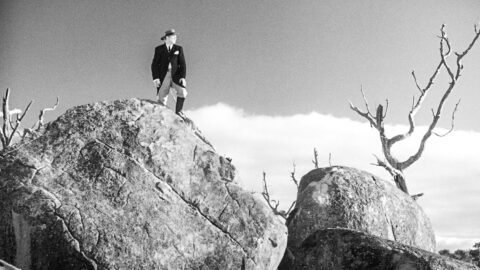
Western conventions abound — horses ridden against the sky, caught in half-frame at the top of a ridge; joyous stick-em-ups and exciting chase scenes; expressive acting and buoyant music — but what’s really exciting is how Holmes, inspired by British greats such as David Lean, Carol Reed and Lawrence Olivier, pokes fun at and subverts the Australian project at the time, constantly referred to by the powers-that-be, as a colonial one.
Cuts to the Australian government in session, losing their head over Thunderbolt’s daring escapes — always operating as a gentleman, mind you; there’s no record that Ward ever shot anyone — show the inefficiency of the government, while scenes of interracial marriage between Blake and his aboriginal lover Maggie (Loretta Boutmy) show a progressive love that challenges the norms of its time (due to the actress’ mixed Melanesian and Maltese heritage, these scenes were cut by British colonial censors). Then there’s the remarkable scene where the judge who passed judgment on Thunderbolt is playing poker with his cronies, the cards laid on a glass table, displayed from underneath, all the while decrying the awfulness of Abraham Lincoln and his desire to abolish slavery. Mid to late 19th-century Australian society is seen as ugly, pretentious and cruel, with people like Thunderbolt the true heroes for sticking it to the man, and by extension, the horrible British Empire.
And despite being the villain, Mannix, much more effective than the police sergeant and childhood friend Sergeant Dalton (John Fegan), is the most entertaining presence, probably because it feels like he is in a different movie entirely. In one sequence, frequenting the “hotels” of the Australian outback, trying to find more information about where Thunderbolt is hiding, he narrates the film like he is in a noir, betraying Holmes love of genre convention and playing around with expectation.
The same goes for certain camera angles: a POV of a revolver going off; a carriage shot from the side, Ward bearing down on it; a concert hall face-off between criminals and police, hemmed in by the crowds in a low, striking angle; and a fight scene in the shadows that could fit easily into the oeuvre of Carol Reed. More than a mere yarn, Captain Thunderbolt is a real ripper. With its full return, let’s hope Holmes’ fantastic film returns to its proper place in the Australian pantheon.
Correction: An earlier version of this review stated incorrectly that Boutmy was in Blackface. This was not the case. We apologise sincerely for the error.
Redmond is the editor-in-chief of Journey Into Cinema.
- Redmond Bacon

- Redmond Bacon

- Redmond Bacon

- Redmond Bacon